The difficult thing about ambitiously joining book clubs and vowing to read more is that I apparently end up with no time to blog about these literary orgies. In chronological order, since I last wrote about the excellent The Argonauts:
- The Handmaid's Tale
- Difficult Women
- I Am Malala
- The Electric Kool-Aid Acid Test
- In the Woods
- Dear Life
- Disgrace
- All the Light We Cannot See
- The Silent Sister
- Mindhunter
- Middlemarch
- Lincoln in the Bardo
Seriously, holy shit.
Underlined are the books that've made me want to sit down and record a reaction because I keep thinking about them. I really LIVED in Middlemarch this winter; it took me forever to get through and will take me forever to blog about. Just finished Lincoln in the Bardo and it gave me Feelings. So anyway, this is my little summary bookmark post for myself and a motivator to get my shit together tomorrow for #backblogging.
Saturday, February 24, 2018

Sunday, April 30, 2017
What's in a Word
Maggie Nelson's The Argonauts is a hell of a unique read. Smart, bold, and an intimate memoir involving things that for a freaking long time were taboo. It's a clinic on gender philosophy and how we talk about who we are. This is totally a book I'll come back to over and over. And you know what? It wasn't even that long.
The Argonauts is a memoir of author Maggie Nelson's pregnancy and relationship with her partner Harriet/Harry Dodge-- the formation of her family and how to describe it. The title alludes to the ship "The Argo" whose parts were replaced over time but whose name stayed the same. New boat, same name. And doesn't this happen all the time in language? "Words are good enough" (p3) but "once we name something ... we can never see it the same way again" (p4) and "words change depending on who speaks them" (p8). What is radical, and what does it mean when one person describes another as radical? Queer? Gay? Lesbian? Male? Female? Gender and language fluidity go hand-in-hand throughout the book.
The middle quote really struck me as YES moment: "once we name something ... we can never see it the same way again". I think about this whenever I read an article about the latest advances in quantum physics, which is one of the few fields where new identifying nomenclature is being coined anymore. Some poor journalist is trying to explain quarks and bosons and I'm over here thinking about these particles existing since the beginning of time but now they have Been Named. This happens a lot in science. Once you name something, you can work with it, you can subjugate it and contextualize it with language and other names.
Nelson points out that often the listener is trapped at the label assigned to the speaker (e.g., gay/lesbian) and can't get beyond it to meaningful discussion (one may observe the parallels to political discourse in this country). Although, while Nelson notes this, I felt like at certain points the book was guilty of it -- Nelson is almost hyper-aware of comments or conversations that could relate to her atypical relationship. "Not everything is about you," I crankily critiqued the memoir ...
Another section I found interesting was a reference to Judith Butler's idea of performative (not performance) gender. To elaborate, in Butler's own words:
"We act and walk and speak and talk that consolidate an impression of being a man or being a women ... we act as if that being of a man or that being of a woman is actually an internal reality or simply something that is true about us. Actually, it is a phenomenon that is being produced all the time and reproduced all the time."
There is a whole body (puns!) of literature on this, so my limited initial understanding is that your (gender) identity is many ways a reflection back from an audience. The production and reproduction of a gender impression involves repetition of societal gender norms and complicit participation in historically gender-based power structures. Bookmarked for further contemplation/reading.
For more: On Judith Butler and Performativity by Sara Salih
And something less dense: Gender Is Not Just a Performance by Julia Serano ... FOR THE COMMENTS SECTION
Other fav moments from The Argonauts:
"[Queer pride is] a refusal to be shamed by witnessing the other as being ashamed of you." (p18)
"How does one get across the fact that the best way to find out how people feel about their gender or their sexuality -- or anything else, really -- is to listen to what they tell you, and to try to treat them accordingly, without shellacking over their version of reality with yours?" (p53)
Bottom line: Excellent. Come prepared to make notes and learn shit and be enlightened.
Book clubs:
Difficult Women by Roxane Gay -- TBD AND I AM VERY EXCITED
I am Malala by Malala Yousafzai -- TBD
The Handmaid's Tale -- It's everywhere! It's in my next blog post!
Small Great Things by Jodie Picoult -- Even though this book involved a bunch of tropes and ham-handedness, it made me mad and it made me reflect. Mostly it made me realize that several things I do could be construed as racist, and that was mortifying. I'm surprised at how much I haven't stopped thinking about this book. Looking to tie this into a future post at some point; just waiting for the right companion book.
The Orphan's Tale by Pam Jenoff -- Fluff.
 |
| The Argo, by Lorenzo Costa |
The Argonauts is a memoir of author Maggie Nelson's pregnancy and relationship with her partner Harriet/Harry Dodge-- the formation of her family and how to describe it. The title alludes to the ship "The Argo" whose parts were replaced over time but whose name stayed the same. New boat, same name. And doesn't this happen all the time in language? "Words are good enough" (p3) but "once we name something ... we can never see it the same way again" (p4) and "words change depending on who speaks them" (p8). What is radical, and what does it mean when one person describes another as radical? Queer? Gay? Lesbian? Male? Female? Gender and language fluidity go hand-in-hand throughout the book.
The middle quote really struck me as YES moment: "once we name something ... we can never see it the same way again". I think about this whenever I read an article about the latest advances in quantum physics, which is one of the few fields where new identifying nomenclature is being coined anymore. Some poor journalist is trying to explain quarks and bosons and I'm over here thinking about these particles existing since the beginning of time but now they have Been Named. This happens a lot in science. Once you name something, you can work with it, you can subjugate it and contextualize it with language and other names.
Nelson points out that often the listener is trapped at the label assigned to the speaker (e.g., gay/lesbian) and can't get beyond it to meaningful discussion (one may observe the parallels to political discourse in this country). Although, while Nelson notes this, I felt like at certain points the book was guilty of it -- Nelson is almost hyper-aware of comments or conversations that could relate to her atypical relationship. "Not everything is about you," I crankily critiqued the memoir ...
Another section I found interesting was a reference to Judith Butler's idea of performative (not performance) gender. To elaborate, in Butler's own words:
"We act and walk and speak and talk that consolidate an impression of being a man or being a women ... we act as if that being of a man or that being of a woman is actually an internal reality or simply something that is true about us. Actually, it is a phenomenon that is being produced all the time and reproduced all the time."
There is a whole body (puns!) of literature on this, so my limited initial understanding is that your (gender) identity is many ways a reflection back from an audience. The production and reproduction of a gender impression involves repetition of societal gender norms and complicit participation in historically gender-based power structures. Bookmarked for further contemplation/reading.
For more: On Judith Butler and Performativity by Sara Salih
And something less dense: Gender Is Not Just a Performance by Julia Serano ... FOR THE COMMENTS SECTION
Other fav moments from The Argonauts:
"[Queer pride is] a refusal to be shamed by witnessing the other as being ashamed of you." (p18)
"How does one get across the fact that the best way to find out how people feel about their gender or their sexuality -- or anything else, really -- is to listen to what they tell you, and to try to treat them accordingly, without shellacking over their version of reality with yours?" (p53)
Bottom line: Excellent. Come prepared to make notes and learn shit and be enlightened.
Book clubs:
Difficult Women by Roxane Gay -- TBD AND I AM VERY EXCITED
I am Malala by Malala Yousafzai -- TBD
The Handmaid's Tale -- It's everywhere! It's in my next blog post!
Small Great Things by Jodie Picoult -- Even though this book involved a bunch of tropes and ham-handedness, it made me mad and it made me reflect. Mostly it made me realize that several things I do could be construed as racist, and that was mortifying. I'm surprised at how much I haven't stopped thinking about this book. Looking to tie this into a future post at some point; just waiting for the right companion book.
The Orphan's Tale by Pam Jenoff -- Fluff.
Sunday, February 12, 2017
A Brief Interlude
1) I was recently educated on the existence of Land Art thanks to Geoff Dyer's White Sands: Experiences from the Outside World, which was not a favorite read but did spur many Google searches. I both can and cannot believe I've lived this long in America and never knew of these places. Just when you start thinking the country is completely overdeveloped, you find out someone's hidden a huge field of metal poles, a futuristic cityscape in the desert and a giant stone spiral in a lake.
Luigi Ghirri (unrelated to Land Art but I think I'm a fan)
"The Lightening Field" by Walter de Maria
"The Spiral Jetty" by Robert Smithson
"Watts Towers" by Sam Rodia
"City" by Michael Heizer
2) As part of a new years resolution to get back to reading and away from the internet (ha!), I've joined two book clubs that both meet monthly. I may work some discussions into this blog, and hopefully I'll be able to keep up the pace and find time to work on my personal to-read list as well. Optimism is rampant.
Last month:
The Girl on the Train by Paula Hawkins -- hated every character but read this in under 48hrs
This month:
Swing Time by Zadie Smith -- first race-related book I've read in forrrreeeverr, looking forward to discussion; also reminded me that her books "White Teeth" and "NW" are on my to-read list too
Small Great Things by Jodie Picoult -- TBD
Saturday, January 28, 2017
Borges Then & Now
I can't start this entry without first linking the hell out of critic Dan Green's excellent blog post, What Is To Be Done? about you-know-who. In particular:
Despite his claims to write plainly, you can pretty much craft a separate thesis from every story in this collection. Stylistically, it's like the lovechild of Kafka and Gabriel Garcia Marquez; weirdly magical stories with nightmarish undertones. What are dreams? What is reality? There are labyrinths, non-linear paths, theories on infinite and the functions of time and math, and a mystical obsession with libraries, books and writing that I really enjoyed. The earlier stories in the collection stuck with me more, but maybe by the end I was just having Borges fatigue. Some favs: "The Babylon Lottery", "The Library of Babel", "The Garden of Forking Paths" and "Tlon, Uqbar, Orbis Tertius". They were so interesting I hate to relegate them to a single sentence all bunched together, but honestly I'd need to reread them like three more times to put together a semi-comprehensive post. Ain't nobody got time for that right now.
Random recurring allusions: Thomas DeQuincey, whose 1882 Confessions of an English Opium-Eater must've been a stylistic influence for Borges, and Martin Fierro, a famous epic Argentinian poem with a John Wayne / Clint Eastwood-esque protagonist.
Bottom line, part I: I'm not head-over-heels with Borges, but I'm intrigued enough to read more of his work (or re-read). What I'd really like to get my hands on and wrap my mind around is a solid Kafka-Borges-Marquez comparative piece.
Bottom line, part II: Going back to the beginning of the post, required reading #2 is to go to Borges' Selected Non-Fictions, page 430, "L'Illusion Comique": "Thus there were two histories: the criminal one, composed of jails, tortures, prostitutions, arsons, and deaths; and the theatrical one, tales and fables made for consumption by dolts."
"Nevertheless, formally adventurous writing, like all truly challenging art, remains itself "subversive" in the way it provides its own kind of resistance ... It resists reduction to pure discourse, to just another way of making an argument or asserting a point of view, which in an era of increasingly simplistic political rhetoric must still count for something. Most importantly, it resists the temptation to certainty, implicitly (and sometimes explicitly) disclosing the contingency not just of our beliefs and actions but as well the very medium such writing uses to depict those beliefs and actions."The debate between "formally adventurous writing" and politically relevant critical writing is also reminiscent of Jorge Luis Borges's critics during the Peron presidency in Argentina (i.e., we have major real-life problems now, forget your existential magical writing crap) -- see also this article in Slate, of all places. I think Borges replies to this in The Paris Review's Art of Fiction interview: "[Joseph] Conrad thought that when one wrote, even in a realistic way, about the world, one was writing a fantastic story because the world itself is fantastic and unfathomable and mysterious," a view that he evidences in his writing with plenty of Schopenhauer the-universe-is-not-rational references. Most of his collected stories in Ficciones are intertwined with truth and fiction, and in the Art of Fiction interview, Borges says of Ficciones: "They were all more or less autobiographical."
Despite his claims to write plainly, you can pretty much craft a separate thesis from every story in this collection. Stylistically, it's like the lovechild of Kafka and Gabriel Garcia Marquez; weirdly magical stories with nightmarish undertones. What are dreams? What is reality? There are labyrinths, non-linear paths, theories on infinite and the functions of time and math, and a mystical obsession with libraries, books and writing that I really enjoyed. The earlier stories in the collection stuck with me more, but maybe by the end I was just having Borges fatigue. Some favs: "The Babylon Lottery", "The Library of Babel", "The Garden of Forking Paths" and "Tlon, Uqbar, Orbis Tertius". They were so interesting I hate to relegate them to a single sentence all bunched together, but honestly I'd need to reread them like three more times to put together a semi-comprehensive post. Ain't nobody got time for that right now.
Random recurring allusions: Thomas DeQuincey, whose 1882 Confessions of an English Opium-Eater must've been a stylistic influence for Borges, and Martin Fierro, a famous epic Argentinian poem with a John Wayne / Clint Eastwood-esque protagonist.
Bottom line, part I: I'm not head-over-heels with Borges, but I'm intrigued enough to read more of his work (or re-read). What I'd really like to get my hands on and wrap my mind around is a solid Kafka-Borges-Marquez comparative piece.
Bottom line, part II: Going back to the beginning of the post, required reading #2 is to go to Borges' Selected Non-Fictions, page 430, "L'Illusion Comique": "Thus there were two histories: the criminal one, composed of jails, tortures, prostitutions, arsons, and deaths; and the theatrical one, tales and fables made for consumption by dolts."
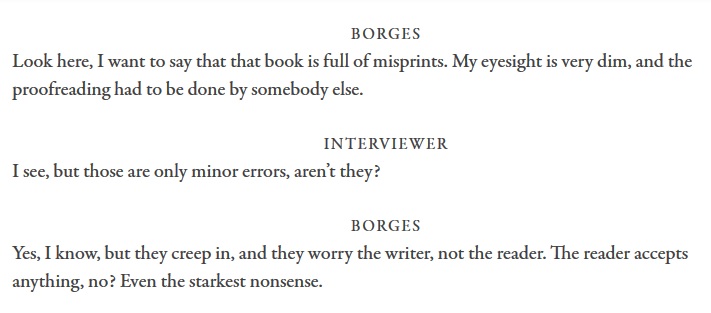 |
| The Paris Review; The Art of Fiction |
Saturday, December 24, 2016
The Half-Year of Paul Bowles
I wanted to title this entry "Bowles Movements" but found it too punny, even for me. Travels: Collected Writings 1950-1993 by Paul Bowles is a series of essays I wanted to read before jetting off to Seville & Marrakesh in late November, and somehow it took me the ENTIRE five to six months before my trip to accomplish this. As in, the back cover was finally reached with mere days until departure. Not that the book was boring -- dense, and a lot of repetition. And then within the 12 days I was on vacation, I plowed through all of Philip Roth's The Human Stain (no notes; liked it but left it in the Marrakesh riad). Suffice to say it's been an atypical year of reading.
First, I thought Bowles was British but he's American. Second, his essays tend to have more humility than the other, actually British Paul (Theroux; see Theroux's Great Railway Bazaar) and are a solid mix of introspection and description. "Now that in theory anyone can go anywhere, the travel book serves a different purpose; emphasis has shifted from the place to the effect of the place upon the person ... the story of what happened to one person in a particular place" (p.239-40). Generally, his essays strike a balance between introspection and expert witness, and he often acknowledges his otherness in Morocco. He reminded me of Peter Matthiessen -- same generation, also American, also enthralled with solitude and natural spaces ("the sublime" as per Alain de Botton):
"Once he has been under the spell of the vast, luminous, silent country, no other place is quite strong enough for him, no other surroundings can provide the supremely satisfying sensation of existing in the midst of something that is absolute. He will go back, whatever the cost in comfort and money, for the absolute has no price." (p.90; on the Sahara)
This quote really resonated with me at Ait Ben Haddou (above), which is a medieval-era fortress between the Sahara and the Atlas Mountains / Marrakesh. You stand at the top by the ruins of an old granary and the wind is coming at you in huge constant gusts and all you can see in any direction is mountains and desert forever, and you think about how for hundreds and hundreds of years this was a caravan stop and how many other people saw this before you and how many other people will see it after you. It's not even a National Park or anything: it just IS, along with the Berbers in their isolated rural villages.
The middle and late essays in the series wax nostalgic as the initial impression of Morocco is changed by politics, technology and the slow march of time. What used to be authentic and inaccessible is now for tourism. This wasn't the foremost thought in my mind when I visited because the first experience tends to scream "HEY YOU'RE NOT IN AMERICA ANYMORE!" a la Bangkok and, I assume, any other major non-Western hub city. The appreciation/nostalgia for layers of a particular place require getting over the initial culture shock, which is difficult on a four-day jaunt. Bowles lived in Morocco for decades; you may as well as a lifelong New Yorker about the differences between the 1970s and today.
Two favorite parting quotes:
"When you ask a question of a Singhalese who does not know English, he is likely to react in a most curious fashion. First he looks swiftly at you, then he looks away, his features retreating into an expression of pleasant contemplation, as if your voice were an agreeable but distant memory that he had just recalled and thought worthwhile to savor briefly." (p.52)
"Now, after traveling around the country, I know approximately as little as I did on my first arrival. However, I've seen a lot of people and places, and at least I have a somewhat more detailed and precise idea of my ignorance than I did in the beginning." (p.207, and the most important thing)
Bowles recorded rural Moroccan music for the Library of Congress in the late 1950s, including this one of Reh dial Beni Bouhiya:
https://www.youtube.com/watch?v=wkXjwYA7X-8
Other references for future exploration:
Charles Flandrau, Viva Mexico!
J.R. Ackerley, Hindoo Holiday
Peter Mayne, The Alleys of Marrakesh
Bottom line, worth picking an essay or three from the bunch otherwise you'll spend six months of your life reading this collection. Relevant reading for before/after traveling to Morocco. I'll be back for the Sahara some day.
First, I thought Bowles was British but he's American. Second, his essays tend to have more humility than the other, actually British Paul (Theroux; see Theroux's Great Railway Bazaar) and are a solid mix of introspection and description. "Now that in theory anyone can go anywhere, the travel book serves a different purpose; emphasis has shifted from the place to the effect of the place upon the person ... the story of what happened to one person in a particular place" (p.239-40). Generally, his essays strike a balance between introspection and expert witness, and he often acknowledges his otherness in Morocco. He reminded me of Peter Matthiessen -- same generation, also American, also enthralled with solitude and natural spaces ("the sublime" as per Alain de Botton):
"Once he has been under the spell of the vast, luminous, silent country, no other place is quite strong enough for him, no other surroundings can provide the supremely satisfying sensation of existing in the midst of something that is absolute. He will go back, whatever the cost in comfort and money, for the absolute has no price." (p.90; on the Sahara)
 |
| Yours truly, from the top of Ait Ben Haddou. |
This quote really resonated with me at Ait Ben Haddou (above), which is a medieval-era fortress between the Sahara and the Atlas Mountains / Marrakesh. You stand at the top by the ruins of an old granary and the wind is coming at you in huge constant gusts and all you can see in any direction is mountains and desert forever, and you think about how for hundreds and hundreds of years this was a caravan stop and how many other people saw this before you and how many other people will see it after you. It's not even a National Park or anything: it just IS, along with the Berbers in their isolated rural villages.
The middle and late essays in the series wax nostalgic as the initial impression of Morocco is changed by politics, technology and the slow march of time. What used to be authentic and inaccessible is now for tourism. This wasn't the foremost thought in my mind when I visited because the first experience tends to scream "HEY YOU'RE NOT IN AMERICA ANYMORE!" a la Bangkok and, I assume, any other major non-Western hub city. The appreciation/nostalgia for layers of a particular place require getting over the initial culture shock, which is difficult on a four-day jaunt. Bowles lived in Morocco for decades; you may as well as a lifelong New Yorker about the differences between the 1970s and today.
 |
| Not in America anymore; Jemaa el Fna at sunset, photo by yours truly. |
Two favorite parting quotes:
"When you ask a question of a Singhalese who does not know English, he is likely to react in a most curious fashion. First he looks swiftly at you, then he looks away, his features retreating into an expression of pleasant contemplation, as if your voice were an agreeable but distant memory that he had just recalled and thought worthwhile to savor briefly." (p.52)
"Now, after traveling around the country, I know approximately as little as I did on my first arrival. However, I've seen a lot of people and places, and at least I have a somewhat more detailed and precise idea of my ignorance than I did in the beginning." (p.207, and the most important thing)
Bowles recorded rural Moroccan music for the Library of Congress in the late 1950s, including this one of Reh dial Beni Bouhiya:
https://www.youtube.com/watch?v=wkXjwYA7X-8
Other references for future exploration:
Charles Flandrau, Viva Mexico!
J.R. Ackerley, Hindoo Holiday
Peter Mayne, The Alleys of Marrakesh
Bottom line, worth picking an essay or three from the bunch otherwise you'll spend six months of your life reading this collection. Relevant reading for before/after traveling to Morocco. I'll be back for the Sahara some day.
Subscribe to:
Posts (Atom)