1) I was recently educated on the existence of Land Art thanks to Geoff Dyer's White Sands: Experiences from the Outside World, which was not a favorite read but did spur many Google searches. I both can and cannot believe I've lived this long in America and never knew of these places. Just when you start thinking the country is completely overdeveloped, you find out someone's hidden a huge field of metal poles, a futuristic cityscape in the desert and a giant stone spiral in a lake.
Luigi Ghirri (unrelated to Land Art but I think I'm a fan)
"The Lightening Field" by Walter de Maria
"The Spiral Jetty" by Robert Smithson
"Watts Towers" by Sam Rodia
"City" by Michael Heizer
2) As part of a new years resolution to get back to reading and away from the internet (ha!), I've joined two book clubs that both meet monthly. I may work some discussions into this blog, and hopefully I'll be able to keep up the pace and find time to work on my personal to-read list as well. Optimism is rampant.
Last month:
The Girl on the Train by Paula Hawkins -- hated every character but read this in under 48hrs
This month:
Swing Time by Zadie Smith -- first race-related book I've read in forrrreeeverr, looking forward to discussion; also reminded me that her books "White Teeth" and "NW" are on my to-read list too
Small Great Things by Jodie Picoult -- TBD
Sunday, February 12, 2017

Saturday, January 28, 2017
Borges Then & Now
I can't start this entry without first linking the hell out of critic Dan Green's excellent blog post, What Is To Be Done? about you-know-who. In particular:
Despite his claims to write plainly, you can pretty much craft a separate thesis from every story in this collection. Stylistically, it's like the lovechild of Kafka and Gabriel Garcia Marquez; weirdly magical stories with nightmarish undertones. What are dreams? What is reality? There are labyrinths, non-linear paths, theories on infinite and the functions of time and math, and a mystical obsession with libraries, books and writing that I really enjoyed. The earlier stories in the collection stuck with me more, but maybe by the end I was just having Borges fatigue. Some favs: "The Babylon Lottery", "The Library of Babel", "The Garden of Forking Paths" and "Tlon, Uqbar, Orbis Tertius". They were so interesting I hate to relegate them to a single sentence all bunched together, but honestly I'd need to reread them like three more times to put together a semi-comprehensive post. Ain't nobody got time for that right now.
Random recurring allusions: Thomas DeQuincey, whose 1882 Confessions of an English Opium-Eater must've been a stylistic influence for Borges, and Martin Fierro, a famous epic Argentinian poem with a John Wayne / Clint Eastwood-esque protagonist.
Bottom line, part I: I'm not head-over-heels with Borges, but I'm intrigued enough to read more of his work (or re-read). What I'd really like to get my hands on and wrap my mind around is a solid Kafka-Borges-Marquez comparative piece.
Bottom line, part II: Going back to the beginning of the post, required reading #2 is to go to Borges' Selected Non-Fictions, page 430, "L'Illusion Comique": "Thus there were two histories: the criminal one, composed of jails, tortures, prostitutions, arsons, and deaths; and the theatrical one, tales and fables made for consumption by dolts."
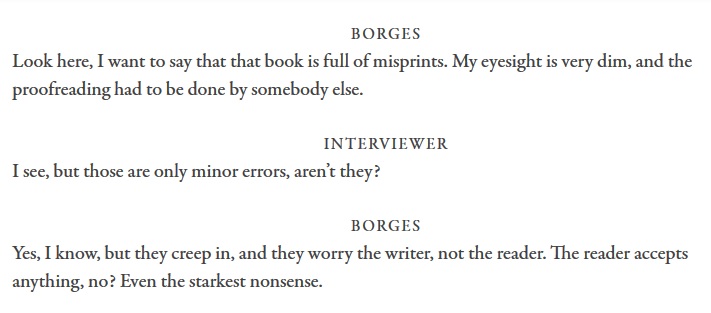
"Nevertheless, formally adventurous writing, like all truly challenging art, remains itself "subversive" in the way it provides its own kind of resistance ... It resists reduction to pure discourse, to just another way of making an argument or asserting a point of view, which in an era of increasingly simplistic political rhetoric must still count for something. Most importantly, it resists the temptation to certainty, implicitly (and sometimes explicitly) disclosing the contingency not just of our beliefs and actions but as well the very medium such writing uses to depict those beliefs and actions."The debate between "formally adventurous writing" and politically relevant critical writing is also reminiscent of Jorge Luis Borges's critics during the Peron presidency in Argentina (i.e., we have major real-life problems now, forget your existential magical writing crap) -- see also this article in Slate, of all places. I think Borges replies to this in The Paris Review's Art of Fiction interview: "[Joseph] Conrad thought that when one wrote, even in a realistic way, about the world, one was writing a fantastic story because the world itself is fantastic and unfathomable and mysterious," a view that he evidences in his writing with plenty of Schopenhauer the-universe-is-not-rational references. Most of his collected stories in Ficciones are intertwined with truth and fiction, and in the Art of Fiction interview, Borges says of Ficciones: "They were all more or less autobiographical."
Despite his claims to write plainly, you can pretty much craft a separate thesis from every story in this collection. Stylistically, it's like the lovechild of Kafka and Gabriel Garcia Marquez; weirdly magical stories with nightmarish undertones. What are dreams? What is reality? There are labyrinths, non-linear paths, theories on infinite and the functions of time and math, and a mystical obsession with libraries, books and writing that I really enjoyed. The earlier stories in the collection stuck with me more, but maybe by the end I was just having Borges fatigue. Some favs: "The Babylon Lottery", "The Library of Babel", "The Garden of Forking Paths" and "Tlon, Uqbar, Orbis Tertius". They were so interesting I hate to relegate them to a single sentence all bunched together, but honestly I'd need to reread them like three more times to put together a semi-comprehensive post. Ain't nobody got time for that right now.
Random recurring allusions: Thomas DeQuincey, whose 1882 Confessions of an English Opium-Eater must've been a stylistic influence for Borges, and Martin Fierro, a famous epic Argentinian poem with a John Wayne / Clint Eastwood-esque protagonist.
Bottom line, part I: I'm not head-over-heels with Borges, but I'm intrigued enough to read more of his work (or re-read). What I'd really like to get my hands on and wrap my mind around is a solid Kafka-Borges-Marquez comparative piece.
Bottom line, part II: Going back to the beginning of the post, required reading #2 is to go to Borges' Selected Non-Fictions, page 430, "L'Illusion Comique": "Thus there were two histories: the criminal one, composed of jails, tortures, prostitutions, arsons, and deaths; and the theatrical one, tales and fables made for consumption by dolts."
 |
| The Paris Review; The Art of Fiction |
Saturday, December 24, 2016
The Half-Year of Paul Bowles
I wanted to title this entry "Bowles Movements" but found it too punny, even for me. Travels: Collected Writings 1950-1993 by Paul Bowles is a series of essays I wanted to read before jetting off to Seville & Marrakesh in late November, and somehow it took me the ENTIRE five to six months before my trip to accomplish this. As in, the back cover was finally reached with mere days until departure. Not that the book was boring -- dense, and a lot of repetition. And then within the 12 days I was on vacation, I plowed through all of Philip Roth's The Human Stain (no notes; liked it but left it in the Marrakesh riad). Suffice to say it's been an atypical year of reading.
First, I thought Bowles was British but he's American. Second, his essays tend to have more humility than the other, actually British Paul (Theroux; see Theroux's Great Railway Bazaar) and are a solid mix of introspection and description. "Now that in theory anyone can go anywhere, the travel book serves a different purpose; emphasis has shifted from the place to the effect of the place upon the person ... the story of what happened to one person in a particular place" (p.239-40). Generally, his essays strike a balance between introspection and expert witness, and he often acknowledges his otherness in Morocco. He reminded me of Peter Matthiessen -- same generation, also American, also enthralled with solitude and natural spaces ("the sublime" as per Alain de Botton):
"Once he has been under the spell of the vast, luminous, silent country, no other place is quite strong enough for him, no other surroundings can provide the supremely satisfying sensation of existing in the midst of something that is absolute. He will go back, whatever the cost in comfort and money, for the absolute has no price." (p.90; on the Sahara)
This quote really resonated with me at Ait Ben Haddou (above), which is a medieval-era fortress between the Sahara and the Atlas Mountains / Marrakesh. You stand at the top by the ruins of an old granary and the wind is coming at you in huge constant gusts and all you can see in any direction is mountains and desert forever, and you think about how for hundreds and hundreds of years this was a caravan stop and how many other people saw this before you and how many other people will see it after you. It's not even a National Park or anything: it just IS, along with the Berbers in their isolated rural villages.
The middle and late essays in the series wax nostalgic as the initial impression of Morocco is changed by politics, technology and the slow march of time. What used to be authentic and inaccessible is now for tourism. This wasn't the foremost thought in my mind when I visited because the first experience tends to scream "HEY YOU'RE NOT IN AMERICA ANYMORE!" a la Bangkok and, I assume, any other major non-Western hub city. The appreciation/nostalgia for layers of a particular place require getting over the initial culture shock, which is difficult on a four-day jaunt. Bowles lived in Morocco for decades; you may as well as a lifelong New Yorker about the differences between the 1970s and today.
Two favorite parting quotes:
"When you ask a question of a Singhalese who does not know English, he is likely to react in a most curious fashion. First he looks swiftly at you, then he looks away, his features retreating into an expression of pleasant contemplation, as if your voice were an agreeable but distant memory that he had just recalled and thought worthwhile to savor briefly." (p.52)
"Now, after traveling around the country, I know approximately as little as I did on my first arrival. However, I've seen a lot of people and places, and at least I have a somewhat more detailed and precise idea of my ignorance than I did in the beginning." (p.207, and the most important thing)
Bowles recorded rural Moroccan music for the Library of Congress in the late 1950s, including this one of Reh dial Beni Bouhiya:
https://www.youtube.com/watch?v=wkXjwYA7X-8
Other references for future exploration:
Charles Flandrau, Viva Mexico!
J.R. Ackerley, Hindoo Holiday
Peter Mayne, The Alleys of Marrakesh
Bottom line, worth picking an essay or three from the bunch otherwise you'll spend six months of your life reading this collection. Relevant reading for before/after traveling to Morocco. I'll be back for the Sahara some day.
First, I thought Bowles was British but he's American. Second, his essays tend to have more humility than the other, actually British Paul (Theroux; see Theroux's Great Railway Bazaar) and are a solid mix of introspection and description. "Now that in theory anyone can go anywhere, the travel book serves a different purpose; emphasis has shifted from the place to the effect of the place upon the person ... the story of what happened to one person in a particular place" (p.239-40). Generally, his essays strike a balance between introspection and expert witness, and he often acknowledges his otherness in Morocco. He reminded me of Peter Matthiessen -- same generation, also American, also enthralled with solitude and natural spaces ("the sublime" as per Alain de Botton):
"Once he has been under the spell of the vast, luminous, silent country, no other place is quite strong enough for him, no other surroundings can provide the supremely satisfying sensation of existing in the midst of something that is absolute. He will go back, whatever the cost in comfort and money, for the absolute has no price." (p.90; on the Sahara)
 |
| Yours truly, from the top of Ait Ben Haddou. |
This quote really resonated with me at Ait Ben Haddou (above), which is a medieval-era fortress between the Sahara and the Atlas Mountains / Marrakesh. You stand at the top by the ruins of an old granary and the wind is coming at you in huge constant gusts and all you can see in any direction is mountains and desert forever, and you think about how for hundreds and hundreds of years this was a caravan stop and how many other people saw this before you and how many other people will see it after you. It's not even a National Park or anything: it just IS, along with the Berbers in their isolated rural villages.
The middle and late essays in the series wax nostalgic as the initial impression of Morocco is changed by politics, technology and the slow march of time. What used to be authentic and inaccessible is now for tourism. This wasn't the foremost thought in my mind when I visited because the first experience tends to scream "HEY YOU'RE NOT IN AMERICA ANYMORE!" a la Bangkok and, I assume, any other major non-Western hub city. The appreciation/nostalgia for layers of a particular place require getting over the initial culture shock, which is difficult on a four-day jaunt. Bowles lived in Morocco for decades; you may as well as a lifelong New Yorker about the differences between the 1970s and today.
 |
| Not in America anymore; Jemaa el Fna at sunset, photo by yours truly. |
Two favorite parting quotes:
"When you ask a question of a Singhalese who does not know English, he is likely to react in a most curious fashion. First he looks swiftly at you, then he looks away, his features retreating into an expression of pleasant contemplation, as if your voice were an agreeable but distant memory that he had just recalled and thought worthwhile to savor briefly." (p.52)
"Now, after traveling around the country, I know approximately as little as I did on my first arrival. However, I've seen a lot of people and places, and at least I have a somewhat more detailed and precise idea of my ignorance than I did in the beginning." (p.207, and the most important thing)
Bowles recorded rural Moroccan music for the Library of Congress in the late 1950s, including this one of Reh dial Beni Bouhiya:
https://www.youtube.com/watch?v=wkXjwYA7X-8
Other references for future exploration:
Charles Flandrau, Viva Mexico!
J.R. Ackerley, Hindoo Holiday
Peter Mayne, The Alleys of Marrakesh
Bottom line, worth picking an essay or three from the bunch otherwise you'll spend six months of your life reading this collection. Relevant reading for before/after traveling to Morocco. I'll be back for the Sahara some day.
Saturday, May 21, 2016
Art Mimicking Life: Villette & Charlotte Bronte
Before I dive into the meat and bones of this post (i.e., fangirling about Charlotte Bronte's Villette) I have to say that I hated Umberto Eco's Island of the Day Before. It sat on my "to read" pile for at least four years and there it should have mouldered forever. I skimmed the last 100-so pages and neither missed nor regretted anything. The main character was a stupid sap and the plot was thin at best, non-existent at worst. I read paragraphs of obscure pseudo-Latin nomenclature that made me want to close my eyes. I kept turning to the front and back covers to verify that yes, respectable people on this planet had favorably reviewed this book. But here is Will Self's review for The Guardian and IT IS GLORIOUS: "The machine I began to long for was one that would automatically read the novels of Umberto Eco, leaving me free to get on with my life."
Finally free of that nightmare, I got on with my life and turned to a trusted author who could revive my flagging reading spirits: Charlotte Bronte and her last novel, Villette. What a totally engrossing, emotional book! I laughed, I cried, I got scared. It's a book I enjoyed reading and would have kept reading for another 500 pages. Had I blogged immediately after, this post would have just consisted of "EEEEEE!!!". So, let's go about this in a more civilized way and briefly look at some parallels between real-life Charlotte Bronte and fictional heroines Lucy Snowe and Jane Eyre. Then deal with that infamous ending.
Villette is narrated by Lucy Snowe, a poor independent woman who has taken an English teaching position in the French town of Villette. Here she is reunited with a handsome former acquaintance from her childhood, Dr. John Graham Bretton, and the ethereal, child-like Polly. Lucy is also introduced to the head mistress of the school, Madame Beck, and the literature professor Monsieur Paul Emanuel. The beginning of the book takes place in Lucy's childhood, with little Polly declaring her love for Dr. John, then a young teen. Things fast forward as Lucy moves on to a nursing position with elderly Miss Marchmont, then fast forward again when Lucy travels to Villette. Of course, Dr. John re-enters the story at this point and there's a whole setup with Lucy developing unrequited romantic feelings towards him. During this little subplot, I'm wondering "but what about crazy Polly" and beginning to notice the literature professor, Monsieur Paul. The second half of the book is where things really take off and Bronte is in absolute virtuoso mode. Lucy and Monsieur Paul's romance doesn't reach the desperate heights of Cathy and Heathcliff, but holy smokes it's a solid second place.
Nabokov advises readers to "identify not with the girl or boy in the book but with the mind that conceived and composed the book" (Lectures on Russian Lit). Jane Eyre and Villette are distorted mirrors to Charlotte Bronte's personal life. Her autobiographical details are not critical to "understanding" either novel but help link them thematically, for example ...
There's family weirdness and tragedy. Both Jane and Lucy had abusive childhoods and strike out on their own as young adults. In real life, the Bronte's mother died early and the children were sent to a girls' school where two of them later died from illness. Charlotte later had multiple positions as a governess and also studied for several years in Brussels (the model for the town of Villette).
Gothic gloom! In Jane Eyre there is the mad wife in the attic, in Villette there is the ghost nun and Lucy's depression (likely informed by Charlotte's own depression at the recent death of her sisters). One critique is that in Villette "the madness is not split off from the central character" and this forms Lucy into a more complex and complete version of Jane (Imagining Characters, p.77).
Passionate and difficult men! Rochester and Monsieur Paul are two versions of the same character, based off Charlotte's professor in Brussels, Monsieur Heger. Dr. John is likely based off Charlotte's publisher, George Smith. The author's romantic feelings for both men were not returned. However, especially in Villette, we get some awesome sexual power dynamics and tension in the back-and-forth dialogues between Lucy and Monsieur Paul. They intentionally provoke each other, fly into rages, reconcile and then do it all over again because they love it. It's EXCELLENT. ("EEEE!!") Speaking of men, another great thing about Villette is that the reader doesn't suffer through a St John Rivers snoozefest subplot. Also see: Hark, a vagrant and Charlotte Bronte's classroom fantasy
Ok, so, SPOILERS! If you want to read Villette and don't know the ending, don't read the end of this post!
There's a persistent interpretation that the very end of Villette is a "double ending" and the reader gets to choose what happened. This is false. There are a handful of hints throughout the book that point to the true ending. 1) Lucy the narrator is an older woman, so the entire story is related after it has already happened and certain phrases are in a past tense where they could be in present; 2) the entire purpose of having Miss Marchmont in the book is so she can tell her tragic story about Frank; 3) when Monsieur Paul is away, Lucy calls it the "three happiest years of my life" (p.448).
So basically Monsieur Paul is finally on his way home across the Atlantic to where he has left Lucy yet-to-be-married but with her own school, then there's a huge storm and this happens:
Let's take it back to sunny with one of my favorite quotes/moments:
"And what did I say to M. Paul Emanuel? Certain junctures of our lives must always be difficult of recall to memory. Certain points, crises, certain feelings, joys, griefs, and amazements, when reviewed, must strike us as things wildered and whirling, dim as a wheel fast spun." (p.442)
Bottom line: Insta-cherish. Keeping this little book next to its sisters to be reread many times in the future.
Finally free of that nightmare, I got on with my life and turned to a trusted author who could revive my flagging reading spirits: Charlotte Bronte and her last novel, Villette. What a totally engrossing, emotional book! I laughed, I cried, I got scared. It's a book I enjoyed reading and would have kept reading for another 500 pages. Had I blogged immediately after, this post would have just consisted of "EEEEEE!!!". So, let's go about this in a more civilized way and briefly look at some parallels between real-life Charlotte Bronte and fictional heroines Lucy Snowe and Jane Eyre. Then deal with that infamous ending.
 |
| Brussels in 1868 (from www.thebrusselsbrontegroup.org) |
 |
| Pensionnat Heger where Charlotte studied in Brussels (from www.thebrusselsbrontegroup.org) |
There's family weirdness and tragedy. Both Jane and Lucy had abusive childhoods and strike out on their own as young adults. In real life, the Bronte's mother died early and the children were sent to a girls' school where two of them later died from illness. Charlotte later had multiple positions as a governess and also studied for several years in Brussels (the model for the town of Villette).
Gothic gloom! In Jane Eyre there is the mad wife in the attic, in Villette there is the ghost nun and Lucy's depression (likely informed by Charlotte's own depression at the recent death of her sisters). One critique is that in Villette "the madness is not split off from the central character" and this forms Lucy into a more complex and complete version of Jane (Imagining Characters, p.77).
Passionate and difficult men! Rochester and Monsieur Paul are two versions of the same character, based off Charlotte's professor in Brussels, Monsieur Heger. Dr. John is likely based off Charlotte's publisher, George Smith. The author's romantic feelings for both men were not returned. However, especially in Villette, we get some awesome sexual power dynamics and tension in the back-and-forth dialogues between Lucy and Monsieur Paul. They intentionally provoke each other, fly into rages, reconcile and then do it all over again because they love it. It's EXCELLENT. ("EEEE!!") Speaking of men, another great thing about Villette is that the reader doesn't suffer through a St John Rivers snoozefest subplot. Also see: Hark, a vagrant and Charlotte Bronte's classroom fantasy
Ok, so, SPOILERS! If you want to read Villette and don't know the ending, don't read the end of this post!
 |
| My experience with the ending. |
There's a persistent interpretation that the very end of Villette is a "double ending" and the reader gets to choose what happened. This is false. There are a handful of hints throughout the book that point to the true ending. 1) Lucy the narrator is an older woman, so the entire story is related after it has already happened and certain phrases are in a past tense where they could be in present; 2) the entire purpose of having Miss Marchmont in the book is so she can tell her tragic story about Frank; 3) when Monsieur Paul is away, Lucy calls it the "three happiest years of my life" (p.448).
So basically Monsieur Paul is finally on his way home across the Atlantic to where he has left Lucy yet-to-be-married but with her own school, then there's a huge storm and this happens:
Here pause: pause at once. There is enough said. Trouble no quiet, kind heart; leave sunny imaginations hope. Let it be theirs to conceive the delight of joy born again fresh out of great terror, the rapture of rescue from peril, the wondrous reprieve from dread, the fruition of return. Let them picture union and a happy succeeding life.The End. We get no coda for Lucy or Monsieur Paul, and "let it be theirs" to conceive joy, "let them" picture a happy ending (but not her). I think I read this final paragraph, really the final three paragraphs, like ten times because I was so shocked. I've now mulled it over for the past week and it still breaks my heart. It's like if Rochester had burned down with his house and attic wife. It's not a "real life is hard" ending because it's still a kind of romantic tragedy and deeply within the world of the novel -- it's appropriate to Lucy's difficult life and story (and Charlotte's, considering the impossibility of a happy ending with Heger). But wow, that one hurts. Find more here: The Valve, Villette Chapters I-42: Farewell
Madame Beck prospered all the days of her life; so did Pere Silas; Madame Walravens fulfilled her ninetieth year before she died. Farewell.
Let's take it back to sunny with one of my favorite quotes/moments:
"And what did I say to M. Paul Emanuel? Certain junctures of our lives must always be difficult of recall to memory. Certain points, crises, certain feelings, joys, griefs, and amazements, when reviewed, must strike us as things wildered and whirling, dim as a wheel fast spun." (p.442)
Bottom line: Insta-cherish. Keeping this little book next to its sisters to be reread many times in the future.
Sunday, March 20, 2016
Flaubert's Postmodern Parrot
Where to begin to unpack this book. After reading Julian Barnes' The Sense of an Ending last year I was anticipating a thoughtful read with Flaubert's Parrot and was not disappointed. The novel comes in just shy of 200 pages and revolves around the narrator's fixation on Gustave Flaubert as he copes with his wife's suicide. Centrally, which exact parrot was used by Flaubert as a model for one of his books? I.e., the search for historical truth. Along the way Barnes experiments with form, uses literature to criticize literary criticism and tricks me into reading another postmodern novel. So there's quite a bit of ground to cover here, even with selective notes.
I'm not a huge fan of random "experimental" sections in books and Barnes throws everything in: acknowledging the audience, biased chronologies, a Flaubertian dictionary, a collegiate exam and a chapter written from the perspective of poet (and sometimes Flaubert lover) Louise Colet. Does the narrator try different styles as part of his search for meaning/truth? Discuss.
The narrator remains nameless up to p.41 and, similar to Sense of an Ending, is unreliable. First he claims: "If you don't know what's true, or what's meant to be true, then the value of what isn't true, or what isn't meant to be true, becomes diminished" (p.77). Almost in order to remedy this within his own story he then follows: "Books are not life ... Ellen's is a true story; perhaps it is even the reason why I am telling you Flaubert's story instead" (p.86). And then: "When a contemporary narrator hesitates, claims uncertainty ... does the reader in fact conclude that reality is being more authentically rendered?" (p.89). It's as if the narrator is criticizing himself within the book. And note the concern for truth/authenticity.
The novel also touches on ye olde well of dark despair/cynicism. Regarding life: "After a number of events, what is there left but repetition and diminishment?" (p.165 and hello Virginia Woolf's To the Lighthouse). Regarding reading: "If all your responses to a book have already been duplicated and expanded upon by a professional critic, then what point is there to your reading? Only that it's yours" (p.166). Reading a professional critical piece about a book isn't equivalent to reading the book.
"Why does the writing make us chase the writer?" (p.12) the narrator asks, and later answers: "Books make sense of life. The only problem is the lives they make sense of are other people's lives, never your own" (p.168).* So instead of Ellen's biography or Geoffrey's autobiography, the reader is offered Flaubert's (removed even further; not making sense of the audience's life, or the narrator's, but a long-dead French author). Throughout the book we follow potential parrot-Flaubert connections that narrow down where the one true parrot may be, but end with uncertainty. The true parrot may be any of these or none of these, and it is impossible to know. Is there significance between Flaubert and all of his parrot-related pseudo-connections, or is it coincidence? The narrator (and reader) must come to accept ambiguity and the unknowable as the "truth" in the case of Flaubert's parrot and his wife's suicide.
*I would argue that through books making sense of someone else's life, by extension they may guide you to make sense of your own. Which goes back to the point that a personal reading is yours, versus the professional critic's.
Returning for a moment to the 'chasing the writer' theme: Many readers, myself included, chase David Foster Wallace. On one level to understand how someone whose writing I connected to so strongly could be so depressed and commit suicide (i.e., to seek meaning), and on another level as an endeavor to possess the beauty of his writing (e.g., here is his autographed book, this writing mattered to me).
Bottom line: You could probably write at least one dissertation on this book. Tough little nut to crack, curious to see if other Barnes books continue to tackle similar themes.
Relevant extra-credit reading: Flaubert's Parrot: fiction and literary criticism
Chase the writer here: Julian Barnes, The Art of Fiction No. 165
 |
| Why hello there, young Gustave! (Wikipedia) |
I'm not a huge fan of random "experimental" sections in books and Barnes throws everything in: acknowledging the audience, biased chronologies, a Flaubertian dictionary, a collegiate exam and a chapter written from the perspective of poet (and sometimes Flaubert lover) Louise Colet. Does the narrator try different styles as part of his search for meaning/truth? Discuss.
The narrator remains nameless up to p.41 and, similar to Sense of an Ending, is unreliable. First he claims: "If you don't know what's true, or what's meant to be true, then the value of what isn't true, or what isn't meant to be true, becomes diminished" (p.77). Almost in order to remedy this within his own story he then follows: "Books are not life ... Ellen's is a true story; perhaps it is even the reason why I am telling you Flaubert's story instead" (p.86). And then: "When a contemporary narrator hesitates, claims uncertainty ... does the reader in fact conclude that reality is being more authentically rendered?" (p.89). It's as if the narrator is criticizing himself within the book. And note the concern for truth/authenticity.
The novel also touches on ye olde well of dark despair/cynicism. Regarding life: "After a number of events, what is there left but repetition and diminishment?" (p.165 and hello Virginia Woolf's To the Lighthouse). Regarding reading: "If all your responses to a book have already been duplicated and expanded upon by a professional critic, then what point is there to your reading? Only that it's yours" (p.166). Reading a professional critical piece about a book isn't equivalent to reading the book.
"Why does the writing make us chase the writer?" (p.12) the narrator asks, and later answers: "Books make sense of life. The only problem is the lives they make sense of are other people's lives, never your own" (p.168).* So instead of Ellen's biography or Geoffrey's autobiography, the reader is offered Flaubert's (removed even further; not making sense of the audience's life, or the narrator's, but a long-dead French author). Throughout the book we follow potential parrot-Flaubert connections that narrow down where the one true parrot may be, but end with uncertainty. The true parrot may be any of these or none of these, and it is impossible to know. Is there significance between Flaubert and all of his parrot-related pseudo-connections, or is it coincidence? The narrator (and reader) must come to accept ambiguity and the unknowable as the "truth" in the case of Flaubert's parrot and his wife's suicide.
*I would argue that through books making sense of someone else's life, by extension they may guide you to make sense of your own. Which goes back to the point that a personal reading is yours, versus the professional critic's.
Returning for a moment to the 'chasing the writer' theme: Many readers, myself included, chase David Foster Wallace. On one level to understand how someone whose writing I connected to so strongly could be so depressed and commit suicide (i.e., to seek meaning), and on another level as an endeavor to possess the beauty of his writing (e.g., here is his autographed book, this writing mattered to me).
"Reading his 'memoirs' is like meeting a man on a train who says, 'Don't look at me, that's misleading. If you want to know what I'm like, wait until we're in a tunnel, and then study my reflection in the window.' You wait, and look, and catch a face against a shifting background ... The transparent shape flickers and jumps, always a few feet away ... Then there is a wail from ahead, a roar and burst of light; the face is gone for ever." (p.96)
Bottom line: You could probably write at least one dissertation on this book. Tough little nut to crack, curious to see if other Barnes books continue to tackle similar themes.
Relevant extra-credit reading: Flaubert's Parrot: fiction and literary criticism
Chase the writer here: Julian Barnes, The Art of Fiction No. 165
Subscribe to:
Posts (Atom)