Saturday, September 7, 2024

A Lengthy Intermission, then Dostoyevsky

I've written stories since the minute I figured out that anyone could write their own stories. For reasons related to the real world and real life, I had pretty much packed up shop for years. I didn't have any inspiration, a lot of older fic websites were gone or abandoned, my laptop was slowly dying, people were writing much more quality material that was above and beyond what used to be out there. I think I made one (1) rough plot outline those five years.

Then, as I was passionately complaining about a fandom dilemma, my sister asked me why I'd stopped writing, and suggested I get back into it. And I thought about it, and came up with the excuses I listed above, and then I realized that really I was just plain intimidated. What if I sucked at it now, what if I didn't know enough about the source material, what if nobody liked it? The last question/fear was what really stuck with me. Nobody's paying me to write material. The most important thing is to write for yourself. So, I decided to write a story with the intention that I would write the entire thing and do multiple proper drafts and proofreading before publishing/posting. I still wasn't sure I wanted to publish/post. What I did want was to devote time to rediscovering and improving my writing, and craft a thematically mature, realistic story. And my takeaway from months of writing and thinking about writing was: I'm never stopping again!  

I wrote through the pandemic lock-down and insane overtime shifts at work, I wrote through pregnancy and now mom life. I wrote batshit insane content. Still am. Writing for yourself is its own reward, and sometimes it's all I do in the half hour at the end of the day when I finally have "me time" -- just set up shop with my silly little characters and write a couple sentences in their silly little scene. 

All this to say, it's hard to find balance between reading and writing when you're dealing with these precious slivers of time. I moved from Riffle to StoryGraph for organizing my ever-growing virtual to-read pile. I knocked out a bunch of books that I don't feel like blogging about, mostly because it's been such slow reading that by the time I finish a book I just want to leave it behind me and not continue to wallow in it. Might do a round-up / catch-up post to list everything because I'm a completist. 

Exception: I finally finally FINALLY read Crime and Punishment by Dostoevksy. I went into this book thinking it was going to be the perfect winter Russian slow-read and was surprised to find it an absolute comedic delight?!  Some top-tier slapstick scenes that are clearly intentionally written as such, just over-the-top dramedy theatricals. A 600-page soap opera that I ate up. Not only is it very funny and tongue-in-cheek, but the main character never actually repents of his murderous crime! The last bit of the book falls into the requisite late-1800s popular shlock of "and then I found Jesus" but it's so shoe-horned in, it feels like someone at the censorship office told Dostoevsky he had to write it. The main character's development arc is basically a flat line but I have to tip my hat to the subversion of expectations -- he did indeed commit a crime and receive punishment and in the end he had no regrets except for the stupid way he committed the crime and his weakness in the face of his guilt afterwards. Bonus points for the 'stripper with a heart of gold' trope and crime-thriller procedural interludes, 1860s Russian style. 

Also really enjoy this quote from Nabokov in Lectures on Russian Literature, re: Dostoevsky: "It is questionable whether one can really discuss the aspects of 'realism' or of 'human experience' when considering an author whose gallery of characters consists almost exclusively of neurotics and lunatics."

This year's 'perfect winter slow-read' is finally finally FINALLY Saint Genet by Sartre, as I try to recapture the magic of my undergrad contemporary drama class with far fewer brain cells. 

Sunday, October 28, 2018

Why "First Reformed" & "Mandy" is the Best Double Feature of the Year

I'm interrupting the regular programming. Occasionally some weirdo movies work their way onto this blog and this year has gifted me with "First Reformed" by Paul Schrader, starring Ethan Hawke, and "Mandy" by Panos Cosmatos, starring Nicolas Cage. One is about a New England priest grappling with despair and the other is a surrealist horror-revenge flick. Each of them is so fucking good and multi-layered and could spur like 200 thesis projects. I can't stop thinking about the striking thematic similarities between them and how the directors approach these themes with completely opposite styles.

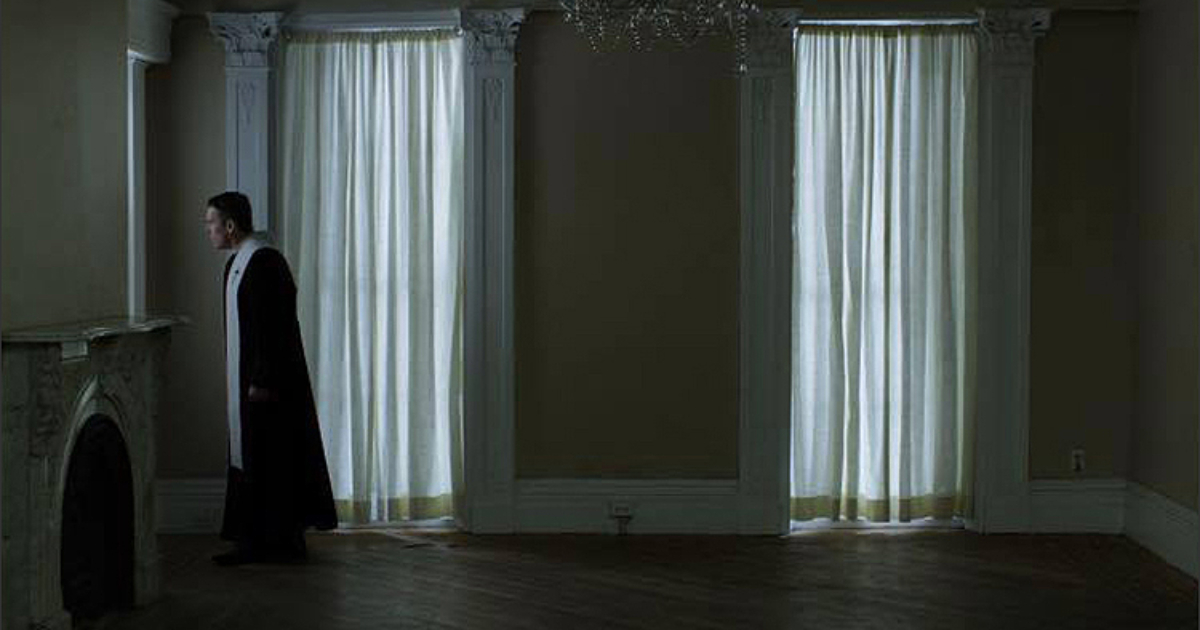
"First Reformed" is purposely austere and cold (very New England-y, huh). The camera is constrained and the shots are long and methodical. We're in a very controlled setting.

Image result for first reformed
seriously there is not even furniture in this room
"Mandy" is all warm reds and psychedelic fuzziness. We get fabulously weird establishing shots of strange landscapes, strobe lighting, you name it. However! Several key first-half shots are long and methodical. The director is also firmly in control here, even when it seems like we've entered bizarro land.
Image result for mandy shadow mountains
welcome to hell
We also see similar angles on the ethereal/savior woman trope. Both main women get trippy fantasy scenes and bookend their respective movies by appearing in the final shots as visions/miracles to the protagonists. Amanda Seyfried and Andrea Riseborough's takes on these two characters are full of depth and strength, despite the differences in storyline. Of course leave it to the women to be the stable people in movies about damaged men ... my eyes just rolled so hard they fell out of their sockets.

Image result for first reformed
a miracle has perhaps appeared, although without furniture
that fateful moment of meeting
Both center around a type of "scripture": Ethan Hawke's priest narrates the movie via journaling and Mandy narrates (symbolic?) scenes from her fantasy novel. And of course there's the other Scripture. These are two movies that frankly involve plots to destroy churches. The cult in "Mandy" and the neighboring commercial-esque church in "First Reformed" exude a religious corruption/wrongness that goes hand-in-hand with the environmentalist themes; destruction of the earth is a sin and these hypocrites have to pay. We even get symbolic dead defenseless animals in both movies!

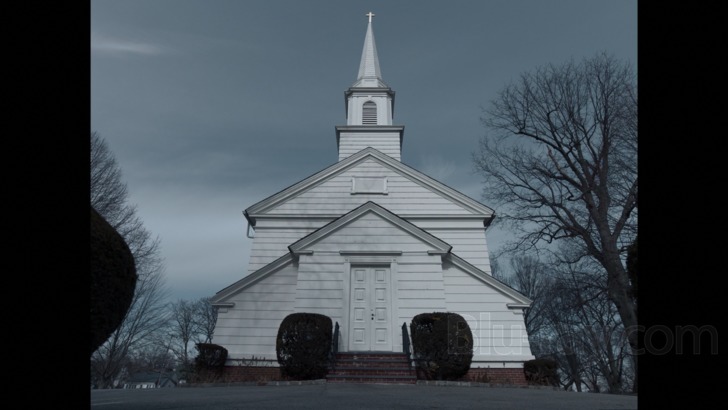
Image result for first reformed
could this church be any less welcoming
fuck it, just burn it all down
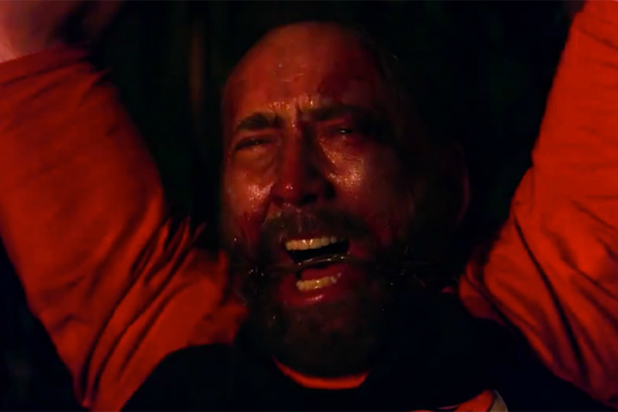
Our protagonists, as played by Ethan Hawke and Nicolas Cage, are two tortured souls trying to manage (poorly) their despair after emotional losses. Rev Toller has lost his son, his marriage, and a parishioner he was trying to counsel. Red has lost the titular character, his wife Mandy. And we're just here along for the ride as they descend into versions of madness. Two of the most emotionally brutal scenes in these movies involve barbed wire, so we as the audience have a cringing visceral reaction to these images of physical pain (manifesting the characters' mental pain). It's hard to watch, and it should be. The culmination of these scenes is to go to the "next level" and realize how fucked up our protagonists have become -- we get Cage's screaming, vodka-chugging scene and Toller's, uh, almost Drain-O-chugging scene. These scenes come at different points in their respective movies, but the effects are very similar.

Related image
this is very unpleasant and close-up
Image result for mandy end scene
this is also very unpleasant and close-up
Finally, there is a fun Hollywood triangle between Ethan Hawke, Nicolas Cage, and Paul Schrader! Schrader directed Cage in "Bringing out the Dead", then Hawke and Cage made "Lord of War" together (with the same director who worked with Hawke on "Gattaca"), then Cage made two more recent movies with Schrader, and now this Hawke/Schrader team-up. Also Hawke and Cage are fans of each other despite (or because of?) complete opposite acting styles. Let's all have a dinner party together, folks. Make it happen. 

Of interest:


Bottom line: Did you not hear me say GO SEE BOTH OF THESE MOVIES IMMEDIATELY

Sunday, September 30, 2018

Tom Wolfe, Twice

Last summer I read The Electric Kool-Aid Acid Test and it gave me anxiety, and then this spring I returned to Tom Wolfe only because I had bought A Man in Full" at a used book sale so why not, and honestly you could've told me these books were written by two different authors.

I love Kerouac's On the Road so I naively expected a similar experience with Kool-Aid -- oh how wrong I was. Yet another book where I kept needing to Wikipedia-verify that I was actually reading a realistic account of real people. I only vaguely knew of Ken Kesey and the LSD scene prior to this book, and obviously my impression of Neal Cassady was from his youth during On the Road, so I was not anticipating an encounter with such total human wreckage. The fact that Kesey wrote One Flew Over the Cuckoo's Nest and then went on to have this wild faked death and fugitive period in Mexico is incredible. I guess this book is a great read for people looking to be dissuaded from doing LSD. As someone who can be a control freak, reading about people living in literal, total, mental chaos gave me this morbid creeping anxiety. The Cow Palace concert with The Beatles is something I've thought of several times since I read this book, where everyone just begins to have a vividly terrible trip.
TL;DR -- Drugs can be not great, Bob.

Wolfe wrote Kool-Aid from the perspective of a journalist a la Hunter S. Thompson (hey look another chaotic anxiety-inducing narrator) and used a stream-of-consciousness style very much like Kerouac. This was fine, but it wasn't inspiring enough for me to want to go out and read more of his work afterwards. I ended up coming back to him through the "to-read" stack and this time it was the fictional/satirical A Man in Full about, I guess, Atlanta in the early 1990s.

A Man in Full was one of the most entertaining books I've ever read, period. If it was about anything, maybe it was about the Stoics and the redemption of a real estate developer and the relationship between black and white in suburban Atlanta and racist policing and trophy wives and Trump and college football and plantation history. There is something for everyone. I loved the characterizations in this book, holy shit. The descriptive writing was pure art-- a sumptuous style that you can really just sink into and enjoy the words and the image it creates in your mind (Cormac McCarthy's Suttree is another book that does this to perfection). Protagonist Conrad Hensley takes a whole damn journey -- his worst chapter was a painful nightmare to read, but after the Stoics get introduced things really take off into a wonderful direction. The plot is improbable and zany, characters come in and out and some of them have no resolution, and I loved it. I didn't want the book to end! Considering it was published back in 1998, it's aged extremely well and many of the power situations in the book are, unfortunately, still evident today. I thought Charlie Croker for the majority of the book could've been a dead ringer for Trump, but maybe that's just where my mind is these days.

Looking back at these books side-by-side and my nearly opposite reactions to them, they both have large and hyper-detailed casts within a loosely-structured story. I just don't think I cared for his stream-of-consciousness style choice in Kool-Aid -- maybe I would've enjoyed that story more if it was written like A Man in Full but you can't really have Kool-Aid without that creepy/crazy style.

Really excited to pick up Bonfire of the Vanities.

"One of the few freedoms that we have as human beings that cannot be taken away from us is the freedom to assent to what is true and to deny what is false. Nothing you can give me is worth surrendering that freedom for. ... What is it you're looking for in this endless quest? Tranquility. You think if only you can acquire enough worldly goods, enough recognition, enough eminence, you will be free, there'll be nothing more to worry about, and instead you become a bigger and bigger slave to how you think others are judging you." -- Charlie Croker

Bottom line: I repeat, A Man in Full was one of the most entertaining books I've ever read.

Post-script: I left this book at the Hong Kong airport bathroom as I was embarking on a trip around Southeast Asia because I just didn't have the luggage space. Hope it found a good home. A few months later, Tom Wolfe died. I saw him years ago giving an author talk at the Philly library for Back to Blood, before I knew anything other than his famous name, and I wish I had read his work earlier. 

Saturday, September 22, 2018

This is Not About Toto's Africa

Americanah by Chimamanda Ngozi Adichie had been on my "to read" list for at least two years and I'd heard nothing but glowing reviews, so imagine my chagrin when I realized I wasn't digging the main character, Ifemelu. Otherwise, the writing was excellent, the story was wide yet detailed with interesting framing and compelling secondary characters. I had to Wikipedia the book to make sure it was independent from "Dear White People" because many of the same points spring up (blogs, racial critiques & racism, Ivy League schools, hair, etc). I spent a lot of this book questioning if I disliked it because I'm a WASPy American and I just didn't "get it" -- also possible, although I was concurrently reading Yaa Ngasi's Homegoing and loving that book, so ... different strokes for different folks?

Homegoing lacked the literal confrontation of Americanah's blog post excerpts and had less fleshed-out characters in favor of a poetic magical-realism vibe that spanned hundreds of years. I couldn't believe this was Ngasi's first novel and can't wait to read more from her. The novel follows two branches of the same family who lose their history because of slave trade. The separate threads continue in Africa vs America until the two re-tie at the conclusion; in general, this is also the plot of Americanah. Ngasi and Adichie are both writing about black identity (loss of, discovery of), but their styles are quite different.

While I thought both books had unwavering focus on the black/African experience, I felt at several points in Americanah that Ifemelu was completely consumed by thinking about her blackness, constantly, to the detriment of more fully realizing her character in the book. Part of this could be that Ifemelu is occasionally (but not exclusively) the author's mouthpiece, and commentary sections that could've been written by the author-as-omniscient-narrator were instead framed as Ifemelu's thoughts and blog entries. Anyway, she was just straight up mean to her closest friends and family and that part of her character never improved. A morality tale this was not. Better summary here.

However, this interview with Adichie was illuminating:
"I think we often expect female characters to be easily likeable, in a way we don't expect male characters to be," the author explains. "Do we expect to like Nabokov's or Roth's characters? No. We expect them to be interesting. And I wanted Ifemelu to be that kind of character, where sometimes you want to smack her and sometimes you want to hold her close. Because I think that's human."
I was immediately reminded of how much I COULD NOT STAND the main character Coleman Silk from Roth's The Human Stain. Interesting? Yes. Did he make that novel excruciatingly frustrating to read? Yes. Was he also a huge dick to his family? Oh yeah. Same deal with Humbert in Lolita and, I fear, whatever the hell is going on in Pale Fire. Look, I understand the naturalism of having your "protagonist" be someone with human faults but I'm also trying to get through a 500-page journey with them. Be kind, I beg of you.

Fav quotes from Homegoing:

"Weakness is treated someone as though they belong to you. Strength is knowing that everyone belongs to themselves." (p38)

"How could he explain to Marjorie that what he wanted to capture with his project was the feeling of time, of having been a part of something that stretched so far back, was so impossibly large, that it was easy to forget that she, and he, and everyone else, existed in it -- not apart from it, but inside of it." (p295)

Bottom line: Both excellent reads about racial identity and separation.


To Recap 75% of 2018...

Well, this year escalated quickly. Quick check-in with what I read this year and what I want to blog about (underlined):

Pachinko
A Man in Full
Hillbilly Elegy
A Higher Loyalty
The Evil That Men Do
Little Fires Everywhere
Homegoing
Americanah

And yes, I am still trying to read "Pale Fire" after misplacing it for five months. 

Sunday, February 25, 2018

A Note on Essays as Memoir

I was super excited to read Roxane Gay after hearing some buzz, and one of my book club picks ended up being her essay collection Difficult Women.

So this essay collection was brutal. Like take-no-prisoners here-is-the-misery. My favorite essay was "North Country" because the writing was just beautifully sparse and evocative. Her straight-forward, short writing style in telling all these painful, emotionally-complex stories was sort of stoic, I guess is the word? What really struck me about halfway through the book were the similarities between almost every essay: grief, child loss, rape, self-harm, "twisted" relationships, general violence. After I finished the book I looked up Roxane Gay's bio and realized one of the final essays really was based on her own trauma.

I think it can be misleading to read too much into fictional text as a reflection of the author, but in this case I believe it's essential to appreciating the whole book. I interpreted it as each essay was an attempt to tell her own story, over and over again, concluding with the essay closest to her actual experience. It was like a kind of fictional PTSD (therapy?), re-living and re-interpreting and trying to find meaning in each new take on the same events. I don't know if this would be a literary version of therapy or the self-harm described in the stories, but it's definitely repetition of a single raw life story -- difficult woman as told through difficult women.

Gay recently came out with her actual memoir, Hunger, so I'm interested to read that and see how these essays fit into the picture.

Bottom line:  This isn't a book I would feel comfortable recommending to any random person, but it's also important that these often-stigmatized types of stories be heard and discussed, and that the reader is taken outside their comfort zone.


Saturday, February 24, 2018

To Recap 2017 ...

The difficult thing about ambitiously joining book clubs and vowing to read more is that I apparently end up with no time to blog about these literary orgies. In chronological order, since I last wrote about the excellent The Argonauts:

- The Handmaid's Tale
- Difficult Women
- I Am Malala
- The Electric Kool-Aid Acid Test
- In the Woods
- Dear Life
- Disgrace
- All the Light We Cannot See
- The Silent Sister
- Mindhunter
- Middlemarch
- Lincoln in the Bardo

Seriously, holy shit.

Underlined are the books that've made me want to sit down and record a reaction because I keep thinking about them. I really LIVED in Middlemarch this winter; it took me forever to get through and will take me forever to blog about. Just finished Lincoln in the Bardo and it gave me Feelings. So anyway, this is my little summary bookmark post for myself and a motivator to get my shit together tomorrow for #backblogging. 

Sunday, April 30, 2017

What's in a Word

Maggie Nelson's The Argonauts is a hell of a unique read. Smart, bold, and an intimate memoir involving things that for a freaking long time were taboo. It's a clinic on gender philosophy and how we talk about who we are. This is totally a book I'll come back to over and over. And you know what? It wasn't even that long.  


The Argo, by Lorenzo Costa

The Argonauts is a memoir of author Maggie Nelson's pregnancy and relationship with her partner Harriet/Harry Dodge-- the formation of her family and how to describe it. The title alludes to the ship "The Argo" whose parts were replaced over time but whose name stayed the same. New boat, same name. And doesn't this happen all the time in language? "Words are good enough" (p3) but "once we name something ... we can never see it the same way again" (p4) and "words change depending on who speaks them" (p8). What is radical, and what does it mean when one person describes another as radical? Queer? Gay? Lesbian? Male? Female? Gender and language fluidity go hand-in-hand throughout the book. 

The middle quote really struck me as YES moment: "once we name something ... we can never see it the same way again". I think about this whenever I read an article about the latest advances in quantum physics, which is one of the few fields where new identifying nomenclature is being coined anymore. Some poor journalist is trying to explain quarks and bosons and I'm over here thinking about these particles existing since the beginning of time but now they have Been Named. This happens a lot in science. Once you name something, you can work with it, you can subjugate it and contextualize it with language and other names. 

Nelson points out that often the listener is trapped at the label assigned to the speaker (e.g., gay/lesbian) and can't get beyond it to meaningful discussion (one may observe the parallels to political discourse in this country). Although, while Nelson notes this, I felt like at certain points the book was guilty of it -- Nelson is almost hyper-aware of comments or conversations that could relate to her atypical relationship. "Not everything is about you," I crankily critiqued the memoir ...  

Another section I found interesting was a reference to Judith Butler's idea of performative (not performance) gender. To elaborate, in Butler's own words:

"We act and walk and speak and talk that consolidate an impression of being a man or being a women ... we act as if that being of a man or that being of a woman is actually an internal reality or simply something that is true about us. Actually, it is a phenomenon that is being produced all the time and reproduced all the time."  

There is a whole body (puns!) of literature on this, so my limited initial understanding is that your (gender) identity is many ways a reflection back from an audience. The production and reproduction of a gender impression involves repetition of societal gender norms and complicit participation in historically gender-based power structures. Bookmarked for further contemplation/reading. 

For more: On Judith Butler and Performativity by Sara Salih
And something less dense: Gender Is Not Just a Performance by Julia Serano ... FOR THE COMMENTS SECTION

Other fav moments from The Argonauts:

"[Queer pride is] a refusal to be shamed by witnessing the other as being ashamed of you." (p18)

"How does one get across the fact that the best way to find out how people feel about their gender or their sexuality -- or anything else, really -- is to listen to what they tell you, and to try to treat them accordingly, without shellacking over their version of reality with yours?" (p53)


Bottom line: Excellent. Come prepared to make notes and learn shit and be enlightened.
Book clubs:

Difficult Women by Roxane Gay -- TBD AND I AM VERY EXCITED

I am Malala by Malala Yousafzai -- TBD

The Handmaid's Tale -- It's everywhere! It's in my next blog post!

Small Great Things by Jodie Picoult -- Even though this book involved a bunch of tropes and ham-handedness, it made me mad and it made me reflect. Mostly it made me realize that several things I do could be construed as racist, and that was mortifying. I'm surprised at how much I haven't stopped thinking about this book. Looking to tie this into a future post at some point; just waiting for the right companion book. 

The Orphan's Tale by Pam Jenoff -- Fluff. 

Sunday, February 12, 2017

A Brief Interlude

1)  I was recently educated on the existence of Land Art thanks to Geoff Dyer's White Sands: Experiences from the Outside World, which was not a favorite read but did spur many Google searches.  I both can and cannot believe I've lived this long in America and never knew of these places. Just when you start thinking the country is completely overdeveloped, you find out someone's hidden a huge field of metal poles, a futuristic cityscape in the desert and a giant stone spiral in a lake.

Luigi Ghirri (unrelated to Land Art but I think I'm a fan)
"The Lightening Field" by Walter de Maria
"The Spiral Jetty" by Robert Smithson
"Watts Towers" by Sam Rodia
"City" by Michael Heizer

 2) As part of a new years resolution to get back to reading and away from the internet (ha!), I've joined two book clubs that both meet monthly. I may work some discussions into this blog, and hopefully I'll be able to keep up the pace and find time to work on my personal to-read list as well. Optimism is rampant.

Last month:

The Girl on the Train by Paula Hawkins -- hated every character but read this in under 48hrs

This month:

Swing Time by Zadie Smith -- first race-related book I've read in forrrreeeverr, looking forward to discussion; also reminded me that her books "White Teeth" and "NW" are on my to-read list too

Small Great Things by Jodie Picoult -- TBD


Saturday, January 28, 2017

Borges Then & Now

I can't start this entry without first linking the hell out of critic Dan Green's excellent blog post, What Is To Be Done? about you-know-who.  In particular:
"Nevertheless, formally adventurous writing, like all truly challenging art, remains itself "subversive" in the way it provides its own kind of resistance ... It resists reduction to pure discourse, to just another way of making an argument or asserting a point of view, which in an era of increasingly simplistic political rhetoric must still count for something. Most importantly, it resists the temptation to certainty, implicitly (and sometimes explicitly) disclosing the contingency not just of our beliefs and actions but as well the very medium such writing uses to depict those beliefs and actions."
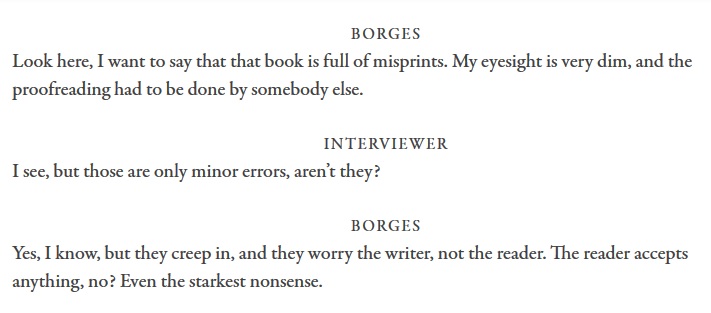
The debate between "formally adventurous writing" and politically relevant critical writing is also reminiscent of Jorge Luis Borges's critics during the Peron presidency in Argentina (i.e., we have major real-life problems now, forget your existential magical writing crap) -- see also this article in Slate, of all places. I think Borges replies to this in The Paris Review's Art of Fiction interview: "[Joseph] Conrad thought that when one wrote, even in a realistic way, about the world, one was writing a fantastic story because the world itself is fantastic and unfathomable and mysterious," a view that he evidences in his writing with plenty of Schopenhauer the-universe-is-not-rational references. Most of his collected stories in Ficciones are intertwined with truth and fiction, and in the Art of Fiction interview, Borges says of Ficciones: "They were all more or less autobiographical."

Despite his claims to write plainly, you can pretty much craft a separate thesis from every story in this collection. Stylistically, it's like the lovechild of Kafka and Gabriel Garcia Marquez; weirdly magical stories with nightmarish undertones. What are dreams? What is reality? There are labyrinths, non-linear paths, theories on infinite and the functions of time and math, and a mystical obsession with libraries, books and writing that I really enjoyed. The earlier stories in the collection stuck with me more, but maybe by the end I was just having Borges fatigue. Some favs: "The Babylon Lottery", "The Library of Babel", "The Garden of Forking Paths" and "Tlon, Uqbar, Orbis Tertius". They were so interesting I hate to relegate them to a single sentence all bunched together, but honestly I'd need to reread them like three more times to put together a semi-comprehensive post. Ain't nobody got time for that right now.

Random recurring allusions: Thomas DeQuincey, whose 1882 Confessions of an English Opium-Eater must've been a stylistic influence for Borges, and Martin Fierro, a famous epic Argentinian poem with a John Wayne / Clint Eastwood-esque protagonist.

Bottom line, part I: I'm not head-over-heels with Borges, but I'm intrigued enough to read more of his work (or re-read). What I'd really like to get my hands on and wrap my mind around is a solid Kafka-Borges-Marquez comparative piece.

Bottom line, part II: Going back to the beginning of the post, required reading #2 is to go to Borges' Selected Non-Fictions, page 430, "L'Illusion Comique": "Thus there were two histories: the criminal one, composed of jails, tortures, prostitutions, arsons, and deaths; and the theatrical one, tales and fables made for consumption by dolts."

The Paris Review; The Art of Fiction


Saturday, December 24, 2016

The Half-Year of Paul Bowles

I wanted to title this entry "Bowles Movements" but found it too punny, even for me. Travels: Collected Writings 1950-1993 by Paul Bowles is a series of essays I wanted to read before jetting off to Seville & Marrakesh in late November, and somehow it took me the ENTIRE five to six months before my trip to accomplish this. As in, the back cover was finally reached with mere days until departure. Not that the book was boring -- dense, and a lot of repetition. And then within the 12 days I was on vacation, I plowed through all of Philip Roth's The Human Stain (no notes; liked it but left it in the Marrakesh riad). Suffice to say it's been an atypical year of reading.

First, I thought Bowles was British but he's American. Second, his essays tend to have more humility than the other, actually British Paul (Theroux; see Theroux's Great Railway Bazaar) and are a solid mix of introspection and description. "Now that in theory anyone can go anywhere, the travel book serves a different purpose; emphasis has shifted from the place to the effect of the place upon the person ... the story of what happened to one person in a particular place" (p.239-40). Generally, his essays strike a balance between introspection and expert witness, and he often acknowledges his otherness in Morocco. He reminded me of Peter Matthiessen -- same generation, also American, also enthralled with solitude and natural spaces ("the sublime" as per Alain de Botton):

"Once he has been under the spell of the vast, luminous, silent country, no other place is quite strong enough for him, no other surroundings can provide the supremely satisfying sensation of existing in the midst of something that is absolute. He will go back, whatever the cost in comfort and money, for the absolute has no price." (p.90; on the Sahara)


Yours truly, from the top of Ait Ben Haddou.

This quote really resonated with me at Ait Ben Haddou (above), which is a medieval-era fortress between the Sahara and the Atlas Mountains / Marrakesh. You stand at the top by the ruins of an old granary and the wind is coming at you in huge constant gusts and all you can see in any direction is mountains and desert forever, and you think about how for hundreds and hundreds of years this was a caravan stop and how many other people saw this before you and how many other people will see it after you. It's not even a National Park or anything: it just IS, along with the Berbers in their isolated rural villages. 

The middle and late essays in the series wax nostalgic as the initial impression of Morocco is changed by politics, technology and the slow march of time. What used to be authentic and inaccessible is now for tourism. This wasn't the foremost thought in my mind when I visited because the first experience tends to scream "HEY YOU'RE NOT IN AMERICA ANYMORE!" a la Bangkok and, I assume, any other major non-Western hub city. The appreciation/nostalgia for layers of a particular place require getting over the initial culture shock, which is difficult on a four-day jaunt. Bowles lived in Morocco for decades; you may as well as a lifelong New Yorker about the differences between the 1970s and today.

Not in America anymore; Jemaa el Fna at sunset, photo by yours truly.

Two favorite parting quotes:

"When you ask a question of a Singhalese who does not know English, he is likely to react in a most curious fashion. First he looks swiftly at you, then he looks away, his features retreating into an expression of pleasant contemplation, as if your voice were an agreeable but distant memory that he had just recalled and thought worthwhile to savor briefly." (p.52)

"Now, after traveling around the country, I know approximately as little as I did on my first arrival. However, I've seen a lot of people and places, and at least I have a somewhat more detailed and precise idea of my ignorance than I did in the beginning." (p.207, and the most important thing)

Bowles recorded rural Moroccan music for the Library of Congress in the late 1950s, including this one of Reh dial Beni Bouhiya:
https://www.youtube.com/watch?v=wkXjwYA7X-8

Other references for future exploration:
Charles Flandrau, Viva Mexico!
J.R. Ackerley, Hindoo Holiday
Peter Mayne, The Alleys of Marrakesh

Bottom line, worth picking an essay or three from the bunch otherwise you'll spend six months of your life reading this collection. Relevant reading for before/after traveling to Morocco. I'll be back for the Sahara some day. 

Saturday, May 21, 2016

Art Mimicking Life: Villette & Charlotte Bronte

Before I dive into the meat and bones of this post (i.e., fangirling about Charlotte Bronte's Villette) I have to say that I hated Umberto Eco's Island of the Day Before. It sat on my "to read" pile for at least four years and there it should have mouldered forever. I skimmed the last 100-so pages and neither missed nor regretted anything. The main character was a stupid sap and the plot was thin at best, non-existent at worst. I read paragraphs of obscure pseudo-Latin nomenclature that made me want to close my eyes. I kept turning to the front and back covers to verify that yes, respectable people on this planet had favorably reviewed this book. But here is Will Self's review for The Guardian and IT IS GLORIOUS: "The machine I began to long for was one that would automatically read the novels of Umberto Eco, leaving me free to get on with my life."

Finally free of that nightmare, I got on with my life and turned to a trusted author who could revive my flagging reading spirits: Charlotte Bronte and her last novel, Villette. What a totally engrossing, emotional book! I laughed, I cried, I got scared. It's a book I enjoyed reading and would have kept reading for another 500 pages. Had I blogged immediately after, this post would have just consisted of "EEEEEE!!!". So, let's go about this in a more civilized way and briefly look at some parallels between real-life Charlotte Bronte and fictional heroines Lucy Snowe and Jane Eyre. Then deal with that infamous ending.
Brussels in 1868 (from www.thebrusselsbrontegroup.org)
Villette is narrated by Lucy Snowe, a poor independent woman who has taken an English teaching position in the French town of Villette. Here she is reunited with a handsome former acquaintance from her childhood, Dr. John Graham Bretton, and the ethereal, child-like Polly. Lucy is also introduced to the head mistress of the school, Madame Beck, and the literature professor Monsieur Paul Emanuel. The beginning of the book takes place in Lucy's childhood, with little Polly declaring her love for Dr. John, then a young teen. Things fast forward as Lucy moves on to a nursing position with elderly Miss Marchmont, then fast forward again when Lucy travels to Villette. Of course, Dr. John re-enters the story at this point and there's a whole setup with Lucy developing unrequited romantic feelings towards him. During this little subplot, I'm wondering "but what about crazy Polly" and beginning to notice the literature professor, Monsieur Paul. The second half of the book is where things really take off and Bronte is in absolute virtuoso mode. Lucy and Monsieur Paul's romance doesn't reach the desperate heights of Cathy and Heathcliff, but holy smokes it's a solid second place.

Pensionnat Heger where Charlotte studied in Brussels (from www.thebrusselsbrontegroup.org)
Nabokov advises readers to "identify not with the girl or boy in the book but with the mind that conceived and composed the book" (Lectures on Russian Lit).  Jane Eyre and Villette are distorted mirrors to Charlotte Bronte's personal life. Her autobiographical details are not critical to "understanding" either novel but help link them thematically, for example ...

There's family weirdness and tragedy. Both Jane and Lucy had abusive childhoods and strike out on their own as young adults. In real life, the Bronte's mother died early and the children were sent to a girls' school where two of them later died from illness. Charlotte later had multiple positions as a governess and also studied for several years in Brussels (the model for the town of Villette).

Gothic gloom! In Jane Eyre there is the mad wife in the attic, in Villette there is the ghost nun and Lucy's depression (likely informed by Charlotte's own depression at the recent death of her sisters). One critique is that in Villette "the madness is not split off from the central character" and this forms Lucy into a more complex and complete version of Jane (Imagining Characters, p.77).

Passionate and difficult men! Rochester and Monsieur Paul are two versions of the same character, based off Charlotte's professor in Brussels, Monsieur Heger. Dr. John is likely based off Charlotte's publisher, George Smith. The author's romantic feelings for both men were not returned. However, especially in Villette, we get some awesome sexual power dynamics and tension in the back-and-forth dialogues between Lucy and Monsieur Paul. They intentionally provoke each other, fly into rages, reconcile and then do it all over again because they love it. It's EXCELLENT. ("EEEE!!") Speaking of men, another great thing about Villette is that the reader doesn't suffer through a St John Rivers snoozefest subplot. Also see: Hark, a vagrant and Charlotte Bronte's classroom fantasy

Ok, so, SPOILERS! If you want to read Villette and don't know the ending, don't read the end of this post! 
My experience with the ending.

There's a persistent interpretation that the very end of Villette is a "double ending" and the reader gets to choose what happened. This is false. There are a handful of hints throughout the book that point to the true ending. 1) Lucy the narrator is an older woman, so the entire story is related after it has already happened and certain phrases are in a past tense where they could be in present; 2) the entire purpose of having Miss Marchmont in the book is so she can tell her tragic story about Frank; 3) when Monsieur Paul is away, Lucy calls it the "three happiest years of my life" (p.448).

So basically Monsieur Paul is finally on his way home across the Atlantic to where he has left Lucy yet-to-be-married but with her own school, then there's a huge storm and this happens:
Here pause: pause at once. There is enough said. Trouble no quiet, kind heart; leave sunny imaginations hope. Let it be theirs to conceive the delight of joy born again fresh out of great terror, the rapture of rescue from peril, the wondrous reprieve from dread, the fruition of return. Let them picture union and a happy succeeding life.
Madame Beck prospered all the days of her life; so did Pere Silas; Madame Walravens fulfilled her ninetieth year before she died. Farewell.
The End. We get no coda for Lucy or Monsieur Paul, and "let it be theirs" to conceive joy, "let them" picture a happy ending (but not her). I think I read this final paragraph, really the final three paragraphs, like ten times because I was so shocked. I've now mulled it over for the past week and it still breaks my heart. It's like if Rochester had burned down with his house and attic wife. It's not a "real life is hard" ending because it's still a kind of romantic tragedy and deeply within the world of the novel -- it's appropriate to Lucy's difficult life and story (and Charlotte's, considering the impossibility of a happy ending with Heger). But wow, that one hurts. Find more here: The Valve, Villette Chapters I-42: Farewell

Let's take it back to sunny with one of my favorite quotes/moments:

"And what did I say to M. Paul Emanuel? Certain junctures of our lives must always be difficult of recall to memory. Certain points, crises, certain feelings, joys, griefs, and amazements, when reviewed, must strike us as things wildered and whirling, dim as a wheel fast spun." (p.442)

Bottom line: Insta-cherish. Keeping this little book next to its sisters to be reread many times in the future.

Sunday, March 20, 2016

Flaubert's Postmodern Parrot

Where to begin to unpack this book. After reading Julian Barnes' The Sense of an Ending last year I was anticipating a thoughtful read with Flaubert's Parrot and was not disappointed. The novel comes in just shy of 200 pages and revolves around the narrator's fixation on Gustave Flaubert as he copes  with his wife's suicide. Centrally, which exact parrot was used by Flaubert as a model for one of his books? I.e., the search for historical truth. Along the way Barnes experiments with form, uses literature to criticize literary criticism and tricks me into reading another postmodern novel. So there's quite a bit of ground to cover here, even with selective notes.

Why hello there, young Gustave! (Wikipedia)

I'm not a huge fan of random "experimental" sections in books and Barnes throws everything in: acknowledging the audience, biased chronologies, a Flaubertian dictionary, a collegiate exam and a chapter written from the perspective of poet (and sometimes Flaubert lover) Louise Colet. Does the narrator try different styles as part of his search for meaning/truth? Discuss.

The narrator remains nameless up to p.41 and, similar to Sense of an Ending, is unreliable. First he claims: "If you don't know what's true, or what's meant to be true, then the value of what isn't true, or what isn't meant to be true, becomes diminished" (p.77). Almost in order to remedy this within his own story he then follows: "Books are not life ... Ellen's is a true story; perhaps it is even the reason why I am telling you Flaubert's story instead" (p.86). And then: "When a contemporary narrator hesitates, claims uncertainty ... does the reader in fact conclude that reality is being more authentically rendered?" (p.89). It's as if the narrator is criticizing himself within the book. And note the concern for truth/authenticity.

The novel also touches on ye olde well of dark despair/cynicism. Regarding life: "After a number of events, what is there left but repetition and diminishment?" (p.165 and hello Virginia Woolf's To the Lighthouse). Regarding reading: "If all your responses to a book have already been duplicated and expanded upon by a professional critic, then what point is there to your reading? Only that it's yours" (p.166). Reading a professional critical piece about a book isn't equivalent to reading the book.

"Why does the writing make us chase the writer?" (p.12) the narrator asks, and later answers: "Books make sense of life. The only problem is the lives they make sense of are other people's lives, never your own" (p.168).* So instead of Ellen's biography or Geoffrey's autobiography, the reader is offered Flaubert's (removed even further; not making sense of the audience's life, or the narrator's, but a long-dead French author). Throughout the book we follow potential parrot-Flaubert connections that narrow down where the one true parrot may be, but end with uncertainty. The true parrot may be any of these or none of these, and it is impossible to know. Is there significance between Flaubert and all of his parrot-related pseudo-connections, or is it coincidence? The narrator (and reader) must come to accept ambiguity and the unknowable as the "truth" in the case of Flaubert's parrot and his wife's suicide.
*I would argue that through books making sense of someone else's life, by extension they may guide you to make sense of your own. Which goes back to the point that a personal reading is yours, versus the professional critic's.  

Returning for a moment to the 'chasing the writer' theme: Many readers, myself included, chase David Foster Wallace. On one level to understand how someone whose writing I connected to so strongly could be so depressed and commit suicide (i.e., to seek meaning), and on another level as an endeavor to possess the beauty of his writing (e.g., here is his autographed book, this writing mattered to me).
"Reading his 'memoirs' is like meeting a man on a train who says, 'Don't look at me, that's misleading. If you want to know what I'm like, wait until we're in a tunnel, and then study my reflection in the window.' You wait, and look, and catch a face against a shifting background ... The transparent shape flickers and jumps, always a few feet away ... Then there is a wail from ahead, a roar and burst of light; the face is gone for ever." (p.96)

Bottom line: You could probably write at least one dissertation on this book. Tough little nut to crack, curious to see if other Barnes books continue to tackle similar themes.

Relevant extra-credit reading: Flaubert's Parrot: fiction and literary criticism
Chase the writer here: Julian Barnes, The Art of Fiction No. 165

Monday, February 8, 2016

Magical Thinking & Walking the Woods

Two reflections on two reads:

1) After saying I had no interest in reading Joan Didion's The Year of Magical Thinking, I succumbed to the allure of the discount book bin and figured I would give Didion another shot, despite still not having read the ONE book of hers I was originally interested in (Slouching Towards Bethlehem). It was sad in a matter-of-factual way. I re-learned that privileged famous people grieve and suffer like the rest of us. I felt her loss even as she talked about multiple homes and Malibu beaches and Corvettes. And that pretty much sums up the extent of my impression.

(Apparently we loved her in 2015? How Joan Didion Became the Ultimate Literary Celebrity & Toward a Unified Theory of Joan Didion)

Bottom line: I'll continue to have a "meh / okay" reaction to Didion that will be either confirmed or rebuffed after Slouching Towards Bethlehem.


2) I zoomed excitedly through Bill Bryson's A Walk in the Woods, subtitled "Rediscovering America on the Appalachian Trail." The book ended and I needed it to keep going for another 200 pages, or 2,000 pages. Returning to my last entry and thoughts on contemporary travel writing, Bryson avoids the "expert witness explaining the natives" trap through his humility and humor -- he's just a out-of-shape everyman who wants to try hiking the trail with his friend, and he happens to be well-informed about the trail's ecological history. There's no soaring rhetoric and little/no existential musings about nature or long-distance hiking ... and that's okay for this story. On a personal note, the book also rekindled a life goal of hiking the AT (section-hiking, not thru-hiking, let's be real). Thanks, Bill Bryson!

Bottom line: Awesome easy read, highly recommend even if you never want to hike the AT!

AT marker at Pen-Mar, photo by yours truly


Sunday, January 24, 2016

Theroux's Great Railway Bazaar

In the 1970's Paul Theroux spent four months on an out-and-back railway journey across Asia from London. Then he published a book about it. The Great Railway Bazaar was fantastic and of course now I want to take an epic train journey too.

Accompanying map from The Great Railway Bazaar (1975)

Theroux's humorous, beautiful descriptions and the characters he meets along the way held my attention across the continent. I empathized with his impatience towards certain passengers, although honestly sometimes he came across as an asshole. I learned that Sri Lanka used to be called Ceylon and that Gokteik Viaduct in Myanmar was built by Pennsylvania Steel in 1900. Theroux's travel fatigue by the end of the book was spot-on and hilarious. Major parts of the book are "so 70's" (hippies, Vietnam) and I'm looking forward to reading the companion sequel, Ghost Train to the Eastern Star, where he retraces his itinerary in 2008.

The only thing that gave me a sour-lemon-face about this book was the Western white male perspective and barely disguised sense of superiority, not unlike another famous book about taking an exotic journey in order to write about it (ahem, Eat Pray Love by Elizabeth Gilbert). For comparison and contrast, I submit The Snow Leopard by Peter Matthiessen.

In an excellent Boston Review piece, Jessa Crispin argues that today's travel writer "sells not only lovely prose and insights into a new land but also the lifestyle of the rootless and adventurous ... If your life is an aspiration, you are a beacon, not a human, and you talk rather than listen." For women travel writers, "the focus of attention is the self" compared to the prototypical male writer who is an "expert witness who explains the native." See also this LA Review of Books piece regarding travel writing as memoir.  The issue with travel writing as memoir is the writer assumes they are "the most interesting person in the room." Crispin argues that rather than explain or self-reflect, the travel writer should first engage and listen by passing the metaphorical microphone.

If I were to lay Crispin's gender comparison out on some sort of travel writer scale, where one end is Elizabeth Gilbert and Cheryl Strayed (female, internal) and the other end is Paul Theroux and British colonialists (male, external), in the middle I would put Matthiessen. The Snow Leopard manages to be equal parts spiritual and physical journey; the reader sees the beauty of Tibetan mountains and the grief of Matthiessen. As an added bonus, the native characters exist beyond caricatures and are integral to the story; the microphone is partially passed.

Crispin's "lifestyle of the rootless and adventurous" is crystallized in the opening of Bazaar: "That [head]cold made leaving all the easier; leaving was a cure: 'Have you tried aspirin?' 'No, I think I'll got to India'" (p.15). Four months later and Theroux's final train ride through Russia is fraught with psychological travel fatigue, followed by missing a Christmas flight home: "Fiction is pure joy -- how sad that I could not reinvent the trip as fiction" (p. 379). I was about to argue that Theroux doesn't really present his story as aspirational, but then I recalled this quote: "All travel is circular ... the grand tour is just the inspired man's way of heading home" (p. 379). In conclusion, here is inspired man Paul Theroux's Instagram account.

Bottom line: Admire the scenery and the writing, give side-eye to the white Western male perspective, then book your own railroad odyssey ASAP.

"The railway bazaar, with its gadgets and passengers, represented the society so completely that to board it was to be challenged by the national character. At times it was like a leisurely seminar, but I also felt on some occasions that it was like being jailed and then assaulted by the monstrously typical." (p. 235)

also mentioned: The Mezzotint by M. R. James

Friday, January 1, 2016

Norman Mailer, First Impressions

An odd first experience with Norman Mailer: very engaging, well-written book (The Naked and the Dead) that took me just about three months to read (why.) and seemed more like it was from 1970's Vietnam than 1948 WWII.  Also odd in that I didn't have any marginalia commentary.

Back in 1948, The Naked and the Dead  was considered a "powerful cultural attack on the sentimentality and heroic quality of wartime culture" (Saving Private Ryan and Postwar Memory, Bodnar), something that would only increase and magnify with Vietnam in 20 years. The majority of the book takes place in the tropical jungle and I really kept forgetting this was WWII. There's the "pointless mission" trope, comedic bureaucracy, the enemy as the victim and the non-heroic qualities of the main male characters. And just for good measure let's throw in religious and sexual subtexts (don't ask, don't tell circa 1940's). Bodnar writes that the characters are "consumed by personal quests of power and destructiveness" -- the same in war as in socioeconomic America. You could probably write an entire thesis on the trifecta of Cummings, Hearn and Croft, all of whom have since become stereotypical characters with bits and pieces in other war fiction (and probably non-fiction). 

Bottom line(s): As I was nearing the end of the book I was reading with a sense of dread and cliche: man, I KNOW what's going to happen next, but I need to read it anyway and it's not going to end well. In fact, it ended better than expected and not as expected. Some surprise twists and turns. The book definitely checks all the boxes for 'postwar critical fiction' but the writing was excellent and I look forward to reading something different by Mailer. Or, since this book was so prescient, what he has to say about Vietnam.


Sunday, September 20, 2015

Transcendentalism at Home & Abroad

I've held off commenting on Peter Matthiessen's The Snow Leopard while I finished Henry David Thoreau's Walden, since the two ended up connecting. Snow Leopard was something I stumbled across at a used bookstore and Walden was background reading for my upcoming New England vacation -- yes, I will be one of those annoying tourist people and yes, I will be posting afterward.

I expected Snow Leopard to be more of an adventure thrill-read and was surprised to find almost all the action was internal, an autobiography of the author's spiritual journey across the Tibetan Plateau in the 1970s. Matthiessen, who died last year, was a naturalist writer, a CIA agent, and the co-founder of The Paris Review -- what a guy. He sets out on a journey across Tibet with renowned biologist and conservationist George Schaller (still living, still renowned) to observe elusive blue sheep and hopefully catch a glimpse of the snow leopard. The underlying second reason is to seek peace and meditate after the early death of his wife from cancer. This isn't dealt with in great melodramatic chapters, but rather in a few scattered paragraphs among straightforward travel prose, which I thought was very affecting. A few notes:

"In other days, I understood mountains differently, seeing in them something that abides ... they appalled me with their 'permanence', with that awful and irrefutable rock-ness that seemed to intensify my sense of my own transience. Perhaps this dread of transience explains our greed for the few gobbets of raw experience in modern life ..." (p.256)

"Left alone, I am overtaken by that northern void ... This stillness to which all returns, this is reality, and soul and sanity have no more meaning here than a gust of snow; such transience and insignificance are exalting, terrifying, all at once ..." (p. 179)

Bharal (blue sheep) in Tibet; photo by George Schaller, source

Both of these quotes speak to the existential power of the "sublime" in nature; see my previous entry on de Botton's The Art of Travel, which really hit the nail on the head. Further:

"The purpose of meditation practice is not enlightenment; it is to pay attention even at unextraordinary times, to be of the present, nothing-but-the-present, to bear this mindfulness of now into each event of ordinary life." (p.257)

Mindfulness, yes! And now let's rewind over 100 years and see what Thoreau had to say about that: "... we are enabled to apprehend at all what is sublime and noble only by the perpetual instilling and drenching of the reality that surrounds us." (p.77, Walden) Side question: is it easier or harder to do this today, in the abundance of Instagram and Twitter as-it-happens updates? Does it detract from reality or illuminate reality?

Matthiessen spends a lot of time discussing Buddhism and Thoreau throws in several references to "Hindoo" beliefs. I guess Eastern spiritualism has a more intuitive connection with nature than Western religion? Or at least lends itself more easily to environmental philosophy? For more on transcendentalism: Stanford Encyclopedia of Philosophy

In minor contrast to Matthiessen, Thoreau goes into the woods seeking to live on his own, in solitude, as a test of his independence/resourcefulness and a way to "stick it to the man" (not a direct quote). A man living off the land and bucking conformity -- the most Americana thing ever. Thoreau also includes chapters on personal economy, the importance of reading, and "the ability of man to elevate his life by a conscious endeavor" (why hello there, Sartre!). In both books, Matthiessen and Thoreau embrace a temporary apart-ness from modern society in the interest of enlightenment. One goes all the way to remote Tibet while the other goes two miles down the road, so I guess it's all about your mindset. See also: thoughts on Into the Wild & the case of Chris McCandless. While Matthiessen and Thoreau avoid McCandless' romanticizing nature, I'd like to point out that Matthiessen leaves his now-motherless young son behind to go into the wilderness. I give that some side-eye.

More naturalist works remain on the reading list, Thoreau's mentor Ralph Waldo Emerson included, and it'll be interesting to compare the individual nuances on transcendentalism and environmental philosophy.

Parting quote: "Time is but the stream I go a-fishing in. I drink at it; but while I drink I see the sandy bottom and detect how shallow it is." (p.78, Walden)

Bottom line: Two transcendental journeys, one into his backyard and the other halfway across the globe. Introspection and nature like peanut butter and jelly. 

Wednesday, July 15, 2015

Summer Reading: Selections from the Smorgasbord

1. The Jungle Book

I started David Grann's The Lost City of Z thinking it was a work of fiction and was pleasantly surprised and intrigued to find it was historical non-fiction. The book follows renowned jungle explorer Percy Fawcett on his ill-fated Amazon expeditions in the early 1900s, when the age of traditional exploration was coming to a close. Similar to the Oliver Sacks book from earlier, I kept pausing to check Wikipedia because ... REALLY? That REALLY happened? Way more entertaining than anticipated and full of disgusting tidbits about the effects of Amazonian insects and climate. Even more exciting than the book (published in 2010) is that the storyline has since advanced in real life (spoiler alert: Amazon's Lost World).

Bottom line: Highly recommend! A fast, fascinating read. David Grann is a cool dude and a talented journalist; I would totally read more of his work.

2.  Hideous Men

Yes, yes, another David Foster Wallace entry.  Unlike the previous short essay collections I've read (Consider the Lobster & A Supposedly Fun Thing), Brief Interviews with Hideous Men was all semi-related short stories. It was also my least favorite, sadly. I thought the tone was depressing and dark, lacking all the YES! moments and hilarity of the other two collections, and while the writing was inventive, it just didn't do it for me. I also kept falling into the author biography trap, where I'd be reading a story thinking, "Is this what the author thought of himself? Is this a transcript of his inner monologue? Because he was depressed? And on meds? And maybe this is how he felt and what he thought about?" It was impossible to read the collection without going through that filter, and I wonder how I would've felt about the book had I NOT known the author's back-story. 

Bottom line: Mostly I agree with this article, The Last Book I Loved:

"... you might add that the word “joy” is not one you would necessarily use to describe the book. Try explaining all this while wondering to yourself if you give David Foster Wallace a pass because it’s such, like, a thing to discuss his books and be seen reading them on the bus."

Sunday, June 7, 2015

Two Readings on Perception: Part II

Alain de Botton's The Art of Travel has been on my reading list for years and I finally found it tucked away at an independent bookstore this summer. Similar to Oliver Sacks' book from Part I, this was the first book of Botton's I've read, after hearing recommendations and accolades for ages. It's an easy read and a little gem; not so much travel essays as musings on travel and the philosophy behind it, with many YES! moments that pretty much guarantee I'll be reading more of his work.

"I had inadvertently brought myself to the island." (p.19) I find this becoming more true in the adult world, where I need to worry about what I've booked for when and what's going to happen at work while I'm gone and also check my text messages and email and Facebook and the news. There's a joy in vacation planning and anticipating escape from the daily grind, but, as Botton points out, the daily grind follows you in habits. It takes a conscious effort to not think about work and not constantly check the smartphone. This was significantly easier on my most recent vacation due to lack of an international roaming plan and overpriced pay-by-the-hour wifi. I had also spent a chunk of change to get where I was going and god damn it, I was going to pay attention to the present moment.

And about that "being present in the moment" thing: I liked Botton's suggestion that we try to adopt a travel mind-set to more local places. Our own neighborhoods seem boring because we see them every day on autopilot and just tune out. When I first moved into the city, sitting at a street-corner cafe and reading was almost thrillingly new. Living the life! While still enjoyable today, it's less of a novelty and I catch myself focused more on where I need to go next and what time is it and wow it's hot outside ...

I LOVED Botton's take on the beauty of nature. LOVED. IT. There was so much YES! and spot-on prose, like this quote: "We may see in nature certain scenes that will stay with us throughout our lives and offer us, every time they enter our consciousness, both a contrast to and relief from present difficulties." (p.151)  He also discusses nature as a way to connect with a "greater power" in a society increasing disillusioned with religious institutions, summarized perfectly here:
"If the world seems unfair or beyond our understanding, sublime places suggest that it is not surprising that things should be thus ... [they] gently move us to acknowledge limitations that we might otherwise encounter with anxiety or anger ... it is the vast spaces of nature that perhaps provide us with the finest, the most respectful reminder of all that exceeds us." (p.176)
cited by Botton: The Rocky Mountains, Landers Peak (Albert Bierstadt, 1863)
Other odds & ends: 
- Flaubert cameo
- relation to art
- why we take souvenirs

Botton line: Come for the relatable themes, stay for the profundity of the prose.

Saturday, June 6, 2015

Two Readings on Perception: Part I

Fresh off The Emperor of All Maladies: A Biography of Cancer, I picked up a collection of clinical stories that had been recommended by a friend, The Man Who Mistook His Wife for a Hat by Oliver Sacks. This is the first book of Sacks' I've read, but I had high expectations as he consistently gets excellent reviews and had a moving NYTimes op-ed piece about his cancer diagnosis a while back: My Own Life

This book blew my mind. I never realized how little I knew about neurological disorders, and how bizarrely interesting they could be. Every chapter had a "WHAAAAT?" moment, to the point where I was getting distracted by Wikipedia tangents related to right hemisphere brain damage. And this book was published back in 1985! I would love to: 1) read an updated equivalent, 2) find out what happened to the patients, 3) what (if any) progress we've made with the disorders, and 4) see what else Sacks has written. So fascinating!

Agnosia in the man who mistook his wife for a hat.
Of particular interest:
- "idiot savants" (now called "savant syndrome" for obvious reasons) and prime numbers; generally the idea that you would perceive the world only through numbers as a compensation for lacking the capacity for "normal" emotional connections. The closest I could come to imagining this was the scene in The Matrix where Neo sees the world in code. Yes, this is the second consecutive blog post dropping a Matrix reference.
- The soothing appeal of music and nature for many of the patients, to where some were only able to function with a degree of "normalcy" while humming a tune.
- This quote, in reference to a woman who vividly recalled a childhood memory she had previously never been aware of, which "suggested to Penfield that the brain retained an almost perfect record of every lifetime's experience" (p. 137). See also: Hyperthymesia. Pause to consider that a moment. Is this how your life flashes before your eyes in a near-death experience? Why can't we access all these memories anytime? (Because it would be too overwhelming and swamp the present?) Is this still the current theory? Actually mind-boggling. I also enjoy realizing the limits of current science when studying the brain; it's the deep-sea of the body. Unexplored science is always inspiring and humbling.

Also of particular interest, with regard to having a scientific/biological explanation for a condition: "This does not detract in the least from their psychological or spiritual significance. If God, or the eternal order, was revealed to Dostoyevsky in seizures, why should not other organic conditions serve as "portals" to the beyond or the unknown?" (p. 130). A potentially dangerous point, yet interesting in the context of ayahuasca, or DMT, which traditionally has been used for religious spirit journeys and has some epic hallucination stories (DMT: You Cannot Imagine a Stranger Drug or a Stranger Experience).

Bottom line: The brain is powerfully weird, people.